
TL;DR:
- Freelancers face significant risks from dark web credential exposure, with over 16 billion credentials currently circulating.
- Implementing measures like breach monitoring, phishing-resistant MFA, and session revocation can drastically reduce vulnerability.
You're a freelancer, which means you're logging into client portals, project management tools, cloud platforms, and payment services every single day. The dark web doesn't care how small your operation is. Understanding how dark web exposes freelancer credentials is more urgent than most freelancers realize, because the dark web currently hosts over 16 billion leaked credentials, and a significant portion of that data includes cloud and developer platform access that freelancers use constantly. The threat isn't abstract. It's sitting in a Telegram channel right now, priced to sell.
Table of Contents
- Key Takeaways
- How dark web exposes freelancer credentials
- What happens when your credentials get out
- Misconceptions that leave freelancers exposed
- Practical steps to detect and respond to credential exposure
- Evaluating your monitoring options
- My take: instinct is not a security strategy
- Protect your freelance credentials with Klaw
- FAQ
Key Takeaways
| Point | Details |
|---|---|
| Scale of exposure | Over 16 billion credentials are currently on the dark web, including platforms freelancers use daily. |
| Telegram vs. dark web | Both channels distribute stolen credentials, but target different tiers of attackers and require separate monitoring. |
| Session tokens beat passwords | Changing your password won't stop infostealer malware that already has your active session token. |
| Compartmentalization fails | Personal and professional accounts are interconnected attack surfaces, not separate risks. |
| Monitoring is not enough alone | Dark web scanning detects leaks early but must be paired with MFA, session revocation, and data hygiene. |
How dark web exposes freelancer credentials
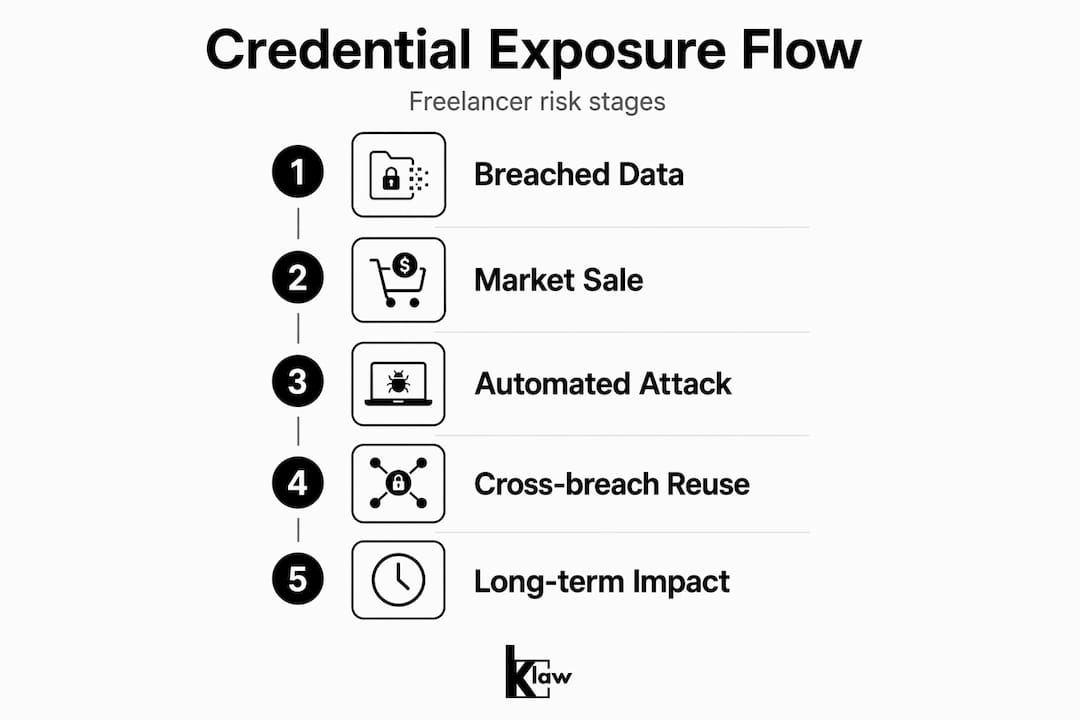
The mechanics behind dark web credential exposure are not random. They follow a structured supply chain that starts with a breach somewhere upstream and ends with your login details being tested against a dozen platforms you use for work.
It begins with the sources. Freelancers interact with a wide ecosystem: invoicing tools, project boards, client communication platforms, file storage, and payment gateways. When any of these platforms suffers a breach, the exposed credentials flow into a few predictable channels. Dark web forums and Telegram serve different operational functions. Forums maintain reputation systems and host high-value, curated data sets sold to sophisticated buyers. Telegram has become a high-volume bulk marketplace where less-skilled criminals buy massive credential lists at commodity prices.
Once credentials land in these markets, automated tools take over. Attackers deploy credential stuffing software that tests stolen logins across hundreds of platforms simultaneously. Because password reuse across platforms is still extremely common, a leaked Netflix password can become the key to your Upwork account, your Google Workspace login, or your client's shared Dropbox folder.
The other major entry point is phishing and malware. Infostealer malware is particularly dangerous because it doesn't just grab your password. It captures active session tokens sitting in your browser, which means attackers can access your accounts without ever needing your password at all.
Here is what typically feeds the dark web pipeline targeting freelancers:
- Breached SaaS platforms that freelancers use for client work, including project management, storage, and communication tools
- Phishing emails disguised as client onboarding requests, payment notifications, or platform security alerts
- Infostealer malware delivered through malicious email attachments or compromised freelance job listings
- Credential stuffing attacks that exploit password reuse across personal and professional accounts
- Unsecured public Wi-Fi used to access client systems, which creates easy interception points for man-in-the-middle attacks
Pro Tip: Use a separate email address exclusively for freelance platform registrations. If that address shows up in a breach scan, you immediately know your work credentials are at risk without it affecting your personal accounts.
Leaked credentials remain valuable long after the initial breach. Attackers combine data sets from multiple breaches to build richer profiles, which makes older leaks just as dangerous as new ones.
What happens when your credentials get out
The consequences of dark web credential exposure for freelancers are not limited to a hacked account. The damage cascades in specific, damaging ways.
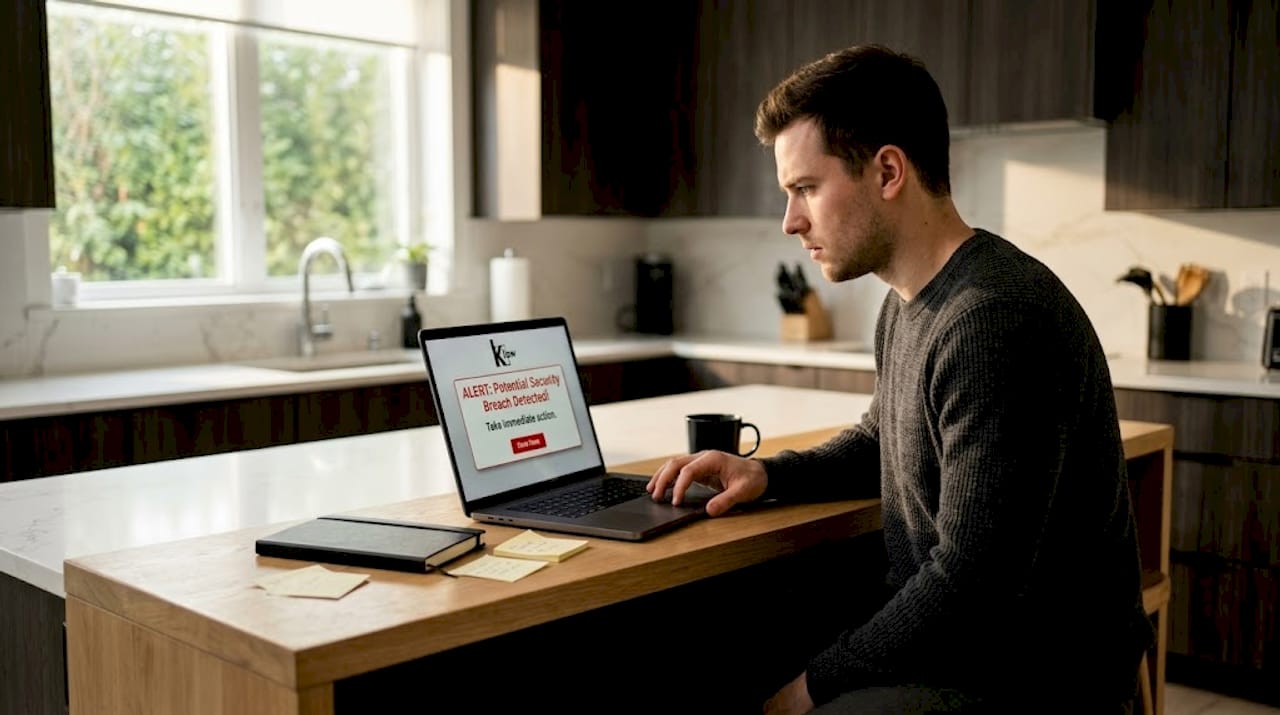
The most immediate risk is business email compromise. Once an attacker controls your email, they can impersonate you to clients, redirect invoice payments, or request sensitive documents. For a freelancer with several active clients, this can mean tens of thousands of dollars in fraudulent transactions before anyone realizes what happened.
Here is how a typical compromise sequence plays out:
- Initial credential sale on a dark web market or Telegram channel, often within 48 hours of the original breach
- Account takeover of the freelancer's primary email or platform account using the stolen login
- Session token exploitation by infostealer malware, allowing continued access even after a password reset
- Client data harvesting through access to shared folders, project briefs, and financial records
- Impersonation and invoice fraud where the attacker contacts clients from the compromised email to redirect payments
The risk of identity theft extends beyond your own accounts. If you store client contracts, tax forms, or business registration documents in your cloud storage, that data becomes part of the attacker's profile on you and on your clients.
Freelancers who store sensitive client files in free cloud storage should understand that many free platforms lack zero-knowledge encryption, meaning a breach of the provider's servers exposes every file you have stored there, regardless of how strong your own password was.
Legal exposure is real too. Depending on your contracts and jurisdiction, a breach of client data that originates from your compromised account could create liability. Some enterprise clients include data security requirements in freelance agreements, and a documented breach on your end could cost you the relationship entirely.
Misconceptions that leave freelancers exposed
Several wrong assumptions keep freelancers from protecting themselves effectively. Getting these straight is the difference between reactive damage control and actual prevention.
Changing your password fixes everything. It doesn't. Infostealer malware captures session tokens that let attackers stay logged in even after you reset your password. A password change without global session revocation leaves every active login still accessible to the attacker. You have to log out of all devices simultaneously to close that window.
Personal and professional accounts are separate risks. They are not. Attackers use automated tools to cross-test credentials across both personal streaming services and professional platforms. A compromised personal account is a potential entry point into your freelance business.
Dark web and Telegram are the same thing. They operate very differently. The dark web hosts sophisticated markets with escrow systems and vendor ratings. Telegram functions as a bulk resale market where stolen data is distributed cheaply and widely. Both represent distinct dark web freelancer risks that require separate monitoring strategies.
If nothing bad has happened yet, you haven't been breached. Credential exploitation is often delayed deliberately. Attackers may sit on stolen credentials for months before acting, waiting for a higher-value opportunity or selling to a buyer who will.
Pro Tip: Run your freelance email address through a breach monitoring scan right now. Don't wait for suspicious activity. Early detection is the only stage where you still control the response.
Practical steps to detect and respond to credential exposure
Knowing the risks is only useful if you act on them. These steps are specifically designed for how freelancers operate, not how large IT departments do.
| Action | What it addresses | Difficulty |
|---|---|---|
| Dark web monitoring scan | Detects if your credentials are already circulating in breach databases | Low |
| Phishing-resistant MFA | Blocks most credential stuffing and account takeover attempts | Low |
| Global session revocation | Terminates active attacker sessions after a suspected breach | Low |
| Zero-knowledge encrypted storage | Protects client files if your cloud provider is breached | Medium |
| Data retention policy | Limits exposure by deleting client files after project completion | Low |
| Avoid dark web job offers | Prevents insider risk and legal exposure from criminal network contact | Low |
Experts recommend phishing-resistant MFA as the single most effective deterrent against credential-based attacks. Hardware security keys or app-based authenticators that require physical confirmation are significantly harder to bypass than SMS codes.
For file storage, the shift to zero-knowledge encrypted platforms is not optional if you handle sensitive client data. These platforms cannot read your files even if compelled, which means a provider-side breach does not expose your clients.
You should also think carefully about dark web job offers or suspicious freelance platform messages that promise unusually high rates for vague technical work. Dark web job boards attract participants with promises of high salaries, but they frequently involve scams, non-payment, and legal liability. Freelancers with specialized technical skills are targeted specifically because their access to client infrastructure makes them valuable to criminal operations. Vet every opportunity through Klaw's security recommendations before engaging with unknown clients who contact you through unconventional channels.
Pro Tip: Set a calendar reminder every 90 days to rotate credentials for your most-used freelance platforms and run a fresh breach scan. Treat it the same way you treat invoicing: a routine, non-negotiable part of running your business.
Evaluating your monitoring options
Not all dark web monitoring services deliver the same coverage, and understanding the gaps helps you choose what's actually useful.
| Monitoring type | Coverage | Best for |
|---|---|---|
| Free email breach scan | Public breach databases | Basic detection of known leaks |
| Dark web forum monitoring | High-value curated credential markets | Detecting targeted or high-volume exposure |
| Telegram channel monitoring | Bulk commodity data markets | Catching mass-distributed leaks early |
| Enterprise incident response | Full forensic analysis and remediation | Post-breach containment and legal compliance |
The gap between free monitoring and paid services is real. Free tools check your email against known public breach databases, which is a good starting point but misses fresh leaks that haven't been indexed yet. Paid or premium services monitor active dark web forums and Telegram channels, giving you faster alerts on credentials that were just put up for sale.
Monitoring also cannot replace foundational security hygiene. A scan that tells you your credentials were leaked three months ago is useful only if you have the controls in place to respond. That means MFA is already active, your 2FA settings are enforced across platforms, and you know how to revoke sessions the moment an alert comes in. Monitoring is the early warning system. Your security practices are the actual defense.
When a breach is confirmed, don't try to manage it alone. If client data was involved, professional incident response services can help you assess the scope, notify affected parties appropriately, and document the response for any contractual or legal requirements.
My take: instinct is not a security strategy
I've watched freelancers treat security like something they'll get to once they're busy enough to afford a breach. The problem is that by the time it feels urgent, it's already too late.
In my experience, the most common failure isn't ignorance. It's compartmentalization. Freelancers know, in theory, that their accounts could be compromised. But they mentally separate "my Netflix password getting leaked" from "my client's financial documents being accessed." Attackers don't respect that separation. They test everything automatically.
What I've learned from watching breach response scenarios play out is that trust on the dark web is manufactured. There are no good actors in those marketplaces, and the systems that look like quality controls exist to make stolen data more sellable, not to protect anyone. Freelancers who think they can navigate that environment on instinct are wrong.
The freelancers who recover quickly from credential exposure share one thing: they had measurable, formal controls already in place before the breach happened. MFA was active. Sessions were logged. Files were deleted after project delivery. Monitoring alerts were set up. They didn't rely on feeling secure. They built systems that gave them evidence.
That shift, from reactive gut-feel to proactive structure, is the most significant security upgrade any freelancer can make. And it costs almost nothing to implement compared to the cost of a single compromised client relationship.
— Lucky
Protect your freelance credentials with Klaw
If you've made it through this article, you already understand the risk better than most freelancers do. The next step is knowing whether your credentials are already circulating on the dark web right now.
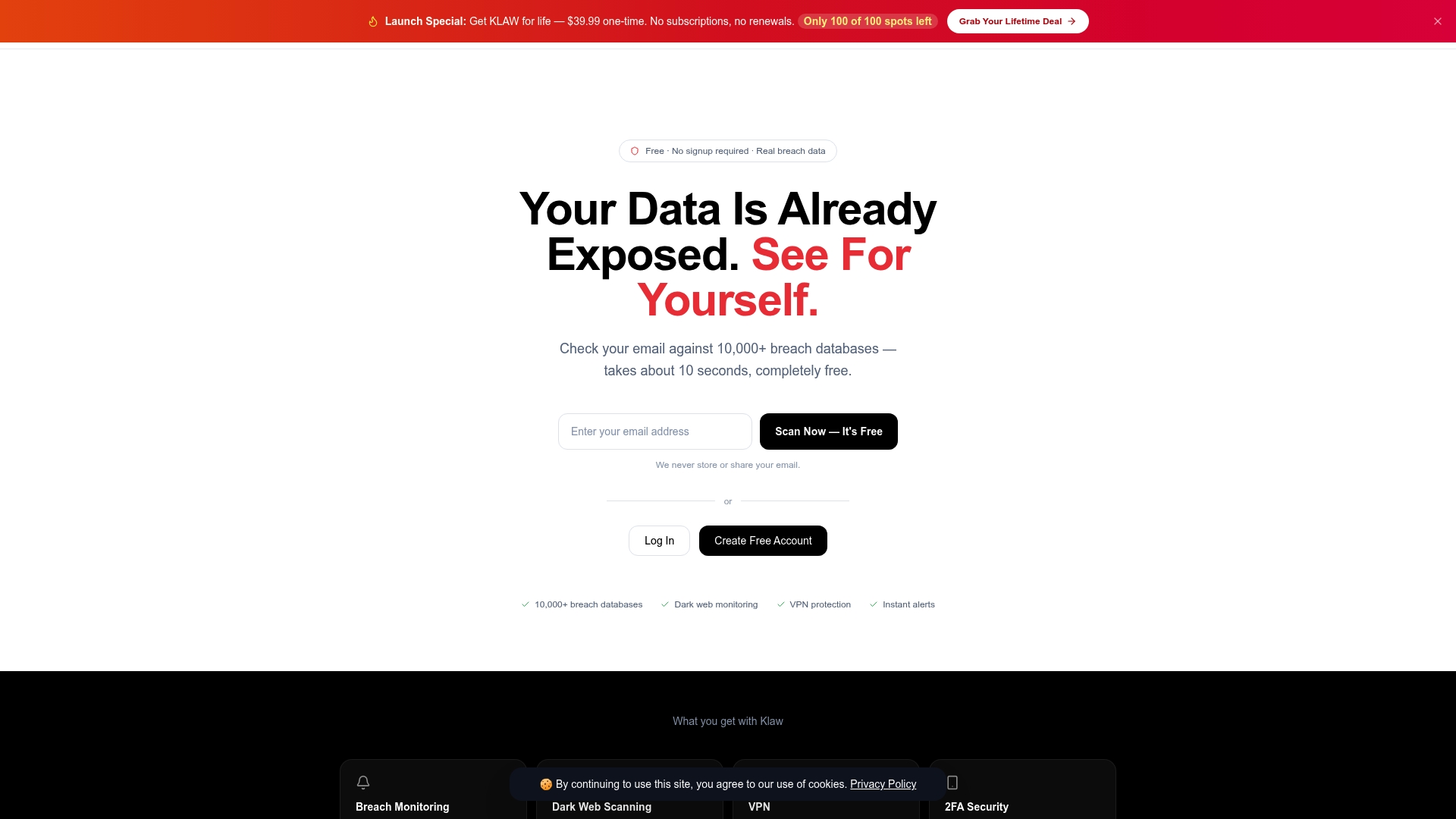
Klaw's dark web monitoring alerts let you scan your email against over 10,000 breach databases for free, giving you an immediate picture of where your credentials stand. From there, you can set up custom threat alert settings tailored to your specific platforms and risk profile. If something is found, Klaw provides guidance on exactly what to do next, from session revocation to automated data broker removals, so you're never left figuring it out alone. Your clients trust you with their data. Make sure you can back that up.
FAQ
What is dark web credential exposure for freelancers?
Dark web credential exposure happens when your usernames, passwords, or session tokens from breached platforms are sold or distributed on dark web markets or Telegram channels. For freelancers, this creates direct risk to client accounts, payment platforms, and professional communication tools.
Does changing my password protect me after a breach?
Not completely. Infostealer malware captures active session tokens that remain valid even after a password change, meaning attackers can stay logged in. You need to revoke all active sessions globally immediately after a suspected breach.
How do I know if my freelance credentials are on the dark web?
Run a breach monitoring scan using a service that checks your email address against multiple breach databases. Klaw offers a free scan across over 10,000 databases, and premium services monitor active dark web forums and Telegram channels for real-time exposure.
Are personal accounts a risk to my freelance business?
Yes. Attackers use automated credential stuffing tools to test personal account passwords against professional platforms. A leaked personal email password can become the entry point for a full business account takeover.
What type of MFA is most effective for freelancers?
Phishing-resistant MFA using a hardware security key or an authenticator app that requires physical confirmation offers significantly stronger protection than SMS-based codes, which can be intercepted through SIM-swapping attacks.