
Your email address has probably appeared in a breach database. You just might not know it yet. The role of breach databases in modern cybersecurity cuts both ways: attackers use them to automate credential theft at scale, while security-conscious individuals can use the same data to catch exposure before it becomes identity theft. With 16 billion credentials now circulating in dark web compilations covering Google, Apple, Facebook, and government portals, the question is no longer whether your data has leaked. It is whether you are watching.
Table of Contents
- Key takeaways
- The role of breach databases: how they work and who uses them
- Why breach monitoring is your personal early-warning system
- Best practices for using breach databases effectively
- Limitations you need to understand
- My honest take on breach databases and what most people get wrong
- Protect your data with Klawusa's monitoring tools
- FAQ
Key takeaways
| Point | Details |
|---|---|
| Breach databases are two-sided | Attackers exploit them for credential stuffing, but individuals can use them to monitor their own exposure. |
| Scale is staggering | Over 16 billion credentials are currently circulating, making one-time checks completely inadequate. |
| Early alerts save you | Breach monitoring often detects leaks before official announcements, giving you a critical response window. |
| Not all breach data is equal | Structured SQL dumps and unstructured paste-site data require different tools to interpret accurately. |
| Monitoring alone is not enough | Combining breach database checks with password hygiene, credit freezes, and dark web alerts is the only reliable defense. |
The role of breach databases: how they work and who uses them
Most people picture a breach database as a single list of stolen passwords. The reality is far more layered. Breach databases are aggregated collections pulled from multiple sources: SQL database dumps stolen during corporate hacks, stealer logs harvested from malware-infected devices, paste-site drops where hackers publicly release data, and dark web marketplaces where fresh leaks are sold privately before going public.
What makes them so dangerous is the unified querying capability they give attackers. Instead of hunting across dozens of separate leaks, a threat actor can search one consolidated platform and pull your email address, associated passwords, physical address, and session tokens in a single query. That is a qualitative leap in attacker efficiency.
Here is how the data flows from breach to exploitation:
- SQL dumps are structured exports of entire databases, often containing usernames, hashed or plaintext passwords, and personal details.
- Combo lists are pre-processed files pairing emails with passwords, optimized specifically for credential stuffing attacks.
- Stealer logs are real-time captures from malware, including saved browser passwords, session cookies, and autofill data.
- Paste-site drops are publicly posted data, often used to advertise a breach or dump low-value records for free.
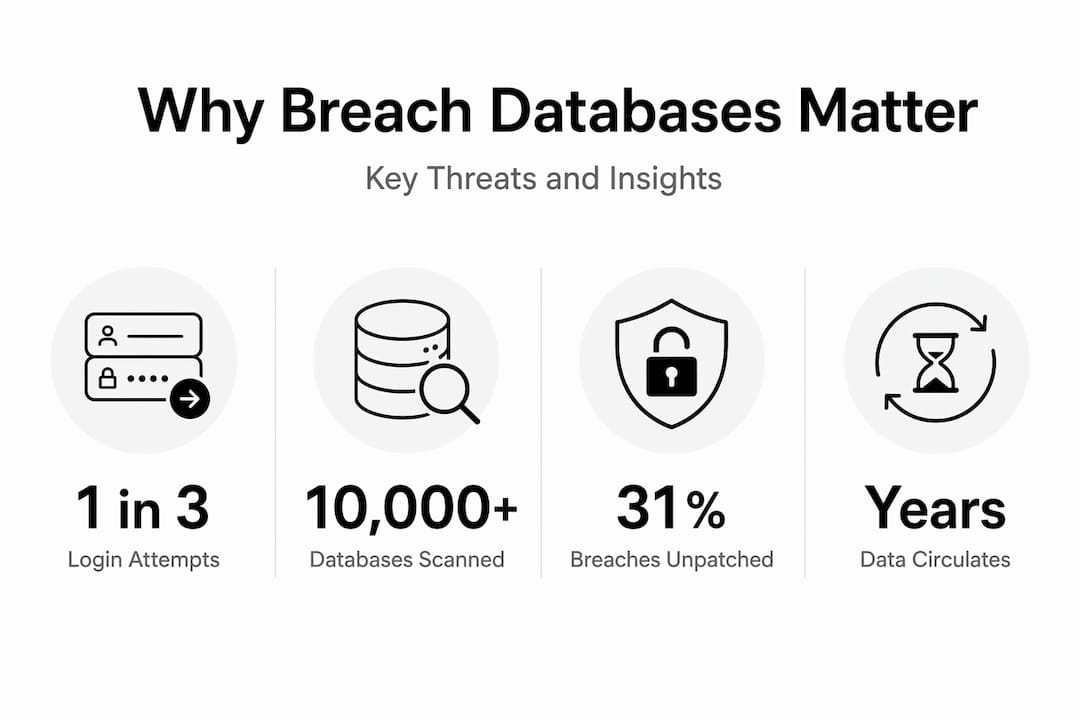
The downstream impact is significant. 1 in 3 enterprise login attempts now use credentials sourced from these compilations. Session hijacking via stolen cookies is rising because those tokens bypass two-factor authentication entirely.
Pro Tip: If you reused a password across multiple sites even years ago, assume it exists in at least one combo list. Treat every old reused password as already compromised.
Why breach monitoring is your personal early-warning system
The importance of breach databases flips when you are on the defensive side. Instead of an attacker querying your data, you are the one checking whether your credentials have surfaced. That shift in perspective is where breach monitoring becomes genuinely useful.

Breach-monitoring services frequently detect leaks before the affected company even issues a public statement. That gap, sometimes days or weeks, is your window to change passwords and lock down accounts before attackers act on the fresh data. Missing that window is costly.
Setting up effective monitoring takes less time than most people expect. Here is a practical sequence:
- Scan your primary email addresses first. Your main email is the skeleton key to most of your accounts. Check it against breach databases before anything else.
- Add secondary emails and usernames. Work addresses, old school emails, and forum usernames all carry exposure risk.
- Set up real-time alerts. One-time checks are a snapshot. Alerts turn monitoring into an ongoing process.
- Review what type of data was exposed. A leaked email alone is different from a leaked email plus plaintext password plus home address. Severity drives your response.
- Validate the breach before panicking. Not every dark web claim is legitimate. Forensic verification is needed to distinguish fresh incidents from recycled old data dressed up as new.
On cost: professional breach-lookup services range from $1.99 per day to $27.99 per three months for unredacted, high-volume access. Basic searches are free on most platforms. For most individuals, a free scan paired with one paid monitoring tier covers the essentials without overspending.
Pro Tip: Use Klawusa's free scan tool to check your email against over 10,000 breach databases before committing to any paid service. It takes under a minute and gives you an immediate baseline.
Best practices for using breach databases effectively
Knowing how breach databases help is one thing. Using them correctly is another. Most people check once after hearing about a major breach and then forget about it entirely. That behavior leaves them exposed to the data recycling problem where old leaks are repackaged and resold as fresh, meaning your credentials can resurface years after the original incident.
Here are the practices that actually move the needle:
- Check multiple email addresses, not just your main one. Old addresses you barely use are often the ones that appear in decade-old breaches that are still circulating.
- Respond differently based on what leaked. A leaked password means rotate it immediately and check for reuse across other sites. A leaked Social Security Number is a different category entirely. SSNs cannot be rotated like passwords. Mitigation requires placing credit freezes with all three bureaus, obtaining an IRS Identity Protection PIN, and monitoring your Social Security Administration account directly.
- Do not rely on a single platform. Different monitoring services index different breach sources. Using two complementary tools gives you broader coverage.
- Pair breach monitoring with data broker removal. Your personal data sitting on data broker sites feeds the same ecosystem. Removing yourself from those sources reduces your attack surface. Klawusa's data broker opt-out service automates this process.
- Treat breach alerts as triggers, not conclusions. An alert tells you something may have leaked. Your job is to act fast, verify the scope, and update credentials before attackers do.
The 2026 Verizon DBIR found that 31% of breaches now stem from unpatched software vulnerabilities, surpassing credential theft at 13%. That means even perfect password hygiene does not fully protect you if the services you use are not patching their systems. Breach database monitoring catches the downstream fallout from those vulnerabilities.
Limitations you need to understand
Breach databases are powerful, but they are not perfect. Understanding where they fall short keeps you from developing false confidence.
| Factor | What it means for you |
|---|---|
| Data recycling | Old breaches get repackaged and resold, making alerts feel new when the data is years old |
| Unstructured vs. structured data | Paste-site drops and PDFs are harder to parse accurately than SQL dumps; specialized tools are needed for each |
| False positives | Your email may appear in a breach that was later found to be fabricated or exaggerated |
| Coverage gaps | No single service indexes every breach; some leaks never reach public monitoring platforms |
| Lag time | Private dark web sales can precede public indexing by weeks or months |
The recycling problem deserves extra attention. Breach data circulates for years after the original incident, often bundled with newer leaks to inflate perceived value. A "new" breach notification might be referencing credentials stolen in 2019. That does not mean you ignore it. It means you cross-reference the breach date with your password history before deciding how urgently to act.
Relying solely on downstream remediation after exposure is a losing strategy. Breach monitoring is one layer of a defense that also needs to include strong unique passwords, two-factor authentication, and regular security audits. None of these layers replaces the others.
My honest take on breach databases and what most people get wrong
I have spent years watching people interact with breach database tools, and the most common mistake is treating a clean result as safety. It is not. A clean result means your data has not surfaced in the databases that particular service indexes. It says nothing about private sales on closed dark web forums, stealer log markets, or breaches that have not been publicly disclosed yet.
The uncomfortable truth is that breach databases have genuinely transformed what attackers can do. The unified console capability they provide means a moderately skilled attacker can now do in minutes what used to require significant technical infrastructure. That asymmetry is real, and no amount of optimism changes it.
What I find encouraging, though, is how much ground individuals can recover by simply being consistent. The people who get hurt worst are not those with the most data exposed. They are the ones who check once, feel relieved, and stop. The people who stay ahead of it treat breach monitoring like they treat checking their bank statements: boring, routine, and non-negotiable.
I also think the industry underestimates how much data broker exposure feeds into breach risk. Your credentials leaking is one problem. Your home address, phone number, and employment history sitting on 200 data broker sites is the context that makes social engineering and targeted attacks possible. Fixing one without the other is incomplete.
Breach databases will keep evolving. AI-assisted querying is already making it faster for attackers to correlate data across multiple leaks. The monitoring tools available to individuals need to keep pace, and the best ones are starting to.
— Lucky
Protect your data with Klawusa's monitoring tools
If reading this article made you want to check your exposure right now, that instinct is correct.
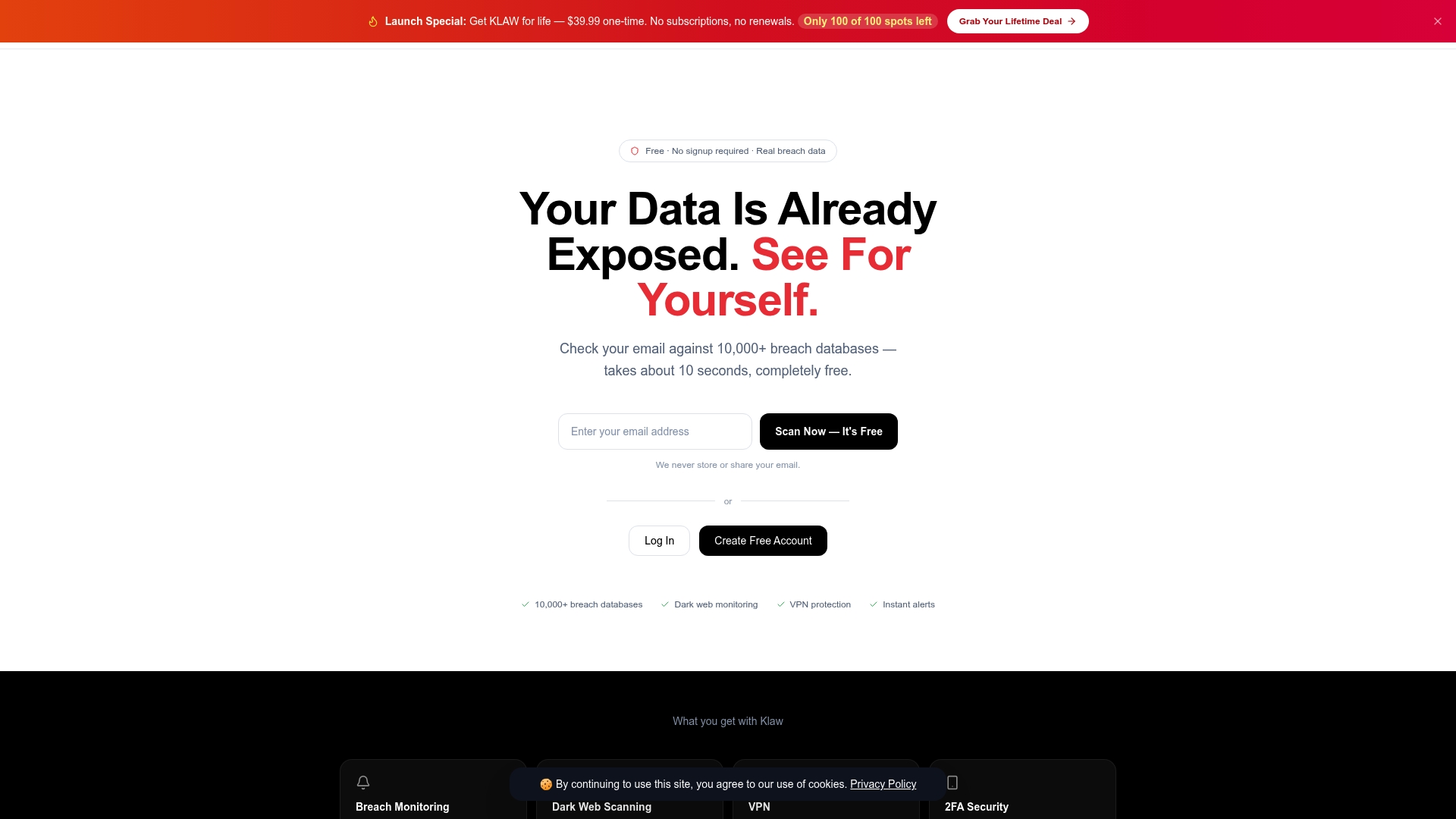
Klawusa scans your email against over 10,000 breach databases for free, with no hidden fees and no subscription required to get started. Their Dark Web Alerts service monitors your data in real time, notifying you the moment your credentials surface in a new compilation. The Security Trend Dashboard gives you a clear view of your current exposure and tracks changes over time. For individuals who want to go further, Klawusa also automates data broker removals and provides VPN access to keep your browsing private while you monitor. No jargon, no complexity. Just clear answers about where your data stands.
FAQ
What is the role of breach databases in cybersecurity?
Breach databases aggregate stolen credentials and personal data from hacks, malware, and dark web markets. They are used by attackers for credential stuffing and by security services to alert individuals when their data has been exposed.
How do breach databases help individuals protect themselves?
Breach monitoring services query these databases on your behalf and send alerts when your email or credentials appear in a new leak, giving you time to change passwords and secure accounts before attackers act.
How often should I check breach databases?
One-time checks are not enough. Because breach data recirculates for years, continuous monitoring with real-time alerts is the only reliable approach for staying informed about your exposure.
What should I do if my Social Security Number is in a breach?
Changing a password does not apply here. Place credit freezes with all three major bureaus, obtain an IRS Identity Protection PIN, and monitor your official Social Security Administration account for suspicious activity.
Are free breach lookup tools reliable?
Free tools provide a useful starting point but typically cover fewer databases than paid services. For thorough coverage, combine a free scan with an ongoing monitoring service that indexes dark web sources and private breach compilations.