
TL;DR:
- Dark web family monitoring continuously scans for exposed personal data to alert families before misuse occurs. Its effectiveness depends on layered defenses, prompt responses, and open communication, as it cannot detect private or encrypted channels. Combining monitoring tools with family conversations and response plans enhances online safety and early threat detection.
Dark web family monitoring is the continuous scanning of hidden online networks for your family's exposed personal data, credentials, and identity assets, alerting you before that information is weaponized. Most parents think the dark web is a distant threat. It is not. Your child's email address, school login, or home address can appear in breach databases within hours of a data incident, and the role of dark web family monitoring is to catch that exposure before someone else acts on it. Tools like Constella, Bark, and VigilKids have made this type of monitoring accessible to non-technical families, turning what was once a corporate security function into a practical layer of home protection.
How does dark web family monitoring work?
Dark web monitoring, more precisely called identity risk intelligence in the security industry, works by continuously crawling publicly accessible dark web sources, paste sites, hacker forums, and breach databases for your family's personal data. When a match is found, an enriched alert is generated with context, risk scoring, and recommended next steps. That process transforms a raw detection into something a parent can actually act on.
Here is what a monitoring service typically scans for:
- Email addresses and passwords exposed in data breaches
- Social Security numbers and dates of birth appearing in identity theft marketplaces
- Home addresses and phone numbers listed in criminal forums
- Children's usernames and gaming handles tied to grooming activity
- Financial account numbers sold in carding shops
One critical limitation: dark web monitoring primarily scans public dark web sources. Private, invitation-only forums and encrypted messaging channels like Telegram groups are largely invisible to automated scanners. This means monitoring is a powerful early-warning layer, not a complete picture of every threat.
For fuller protection, dark web scanning works best alongside device monitoring, app behavior tracking, and browser controls. Each layer catches what the others miss. Constella's identity risk intelligence model, for example, adds context to every alert so parents understand not just what was found but what to do next.

Why is dark web monitoring important for families?
The dark web is not just a place where stolen credit card numbers change hands. It is an active hub for some of the most serious threats children face online, including grooming, exploitation, and identity theft targeting minors.
The scale of child-related risk on anonymized networks is documented and alarming. Research from Tampere University found that 20% of Tor onion sites hosted child sexual abuse material by 2023, with 11% of all Tor searches explicitly seeking it. That statistic means one in five hidden sites on the most widely used dark web network contains material that directly harms children.
"Child exploitation content is widespread on anonymized networks. Prevention hinges on early detection and liaison with law enforcement, not direct parental intervention on dark web sites."
Law enforcement has confirmed the scale of organized activity. Europol's Operation Alice shut down over 373,000 dark web sites advertising child sexual abuse material and identified approximately 440 customers. That operation required years of intelligence gathering. Early detection tools give families a way to contribute to that chain of awareness without putting themselves at risk.
Beyond exploitation, the threats to children include identity theft, account takeover using stolen credentials, and exposure to cybercrime services that can be purchased cheaply on dark web markets. A child's identity is particularly valuable to criminals because it often goes unmonitored for years. Dark web safety for families means catching these exposures early, when a password reset or a fraud alert can still prevent serious harm.
What are the limitations of dark web monitoring?
Understanding what monitoring cannot do is just as important as knowing what it can. Parents who expect a monitoring tool to catch every threat will make worse decisions than parents who understand the boundaries clearly.
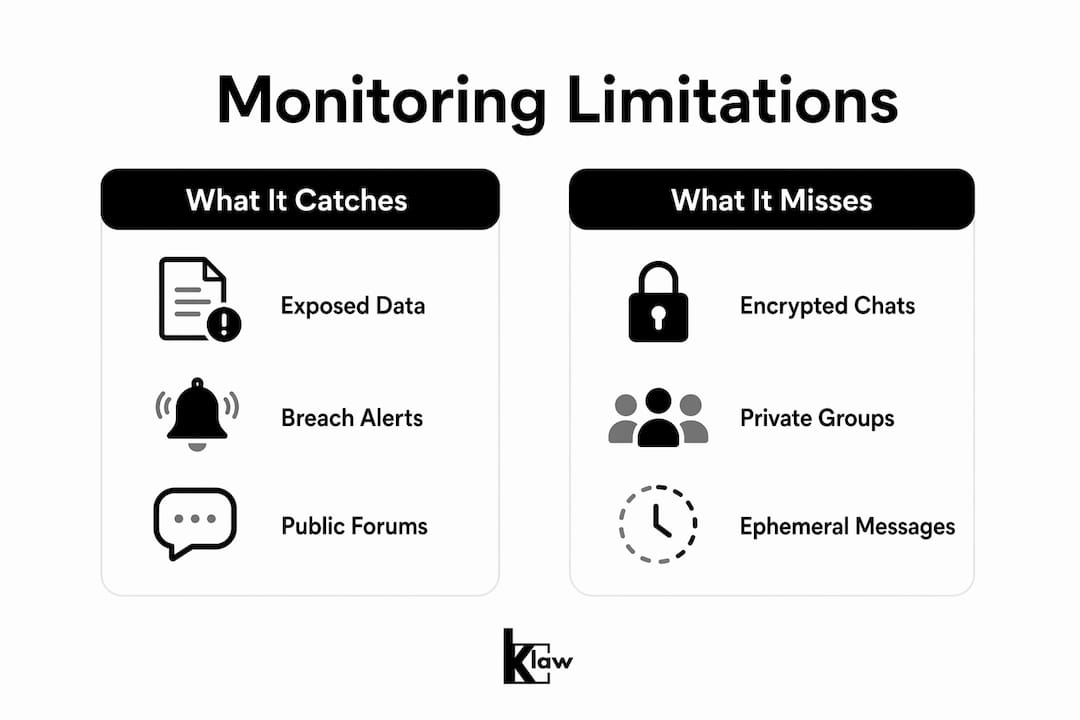
The most significant gap is encrypted and ephemeral communication. Monitoring blind spots include private Telegram channels, Signal groups, and invitation-only forums where much of the most dangerous activity now occurs. No commercial family monitoring product currently scans these channels reliably.
Device-level parental controls have their own gaps. A 2026 review of eight parental control apps found that some apps only read notifications, missing deleted messages and voice notes entirely. Only forensic-capture tools that record content at the moment of receipt catch what gets deleted seconds later. That distinction matters enormously when the threat involves grooming conversations a child has been coached to erase.
| Monitoring type | What it catches | What it misses |
|---|---|---|
| Dark web scanning | Breached credentials, exposed PII in public forums | Private forums, encrypted channels, ephemeral content |
| Notification-reading apps | Visible message previews | Deleted messages, voice notes, disappearing content |
| Forensic-capture apps | Full message content at receipt | Fully encrypted end-to-end platforms with no server copy |
| Browser controls | Known harmful sites | New domains, VPN bypass, private browsing |
Alerts without a response plan are also ineffective. The value of monitoring is not the number of alerts generated but how fast your family acts on them compared to how fast an attacker acts on the same exposed data. A family that receives an alert and waits three days to change a password has lost the advantage monitoring was designed to provide.
Pro Tip: Write a one-page family response plan before you activate any monitoring tool. It should cover who reviews alerts, what triggers a password change, and when to contact authorities. Having that plan in place means you act in minutes, not days.
How can parents combine monitoring with practical protection?
Monitoring alerts are the starting point, not the finish line. The families that get the most protection from these tools are the ones who pair alerts with open conversations, layered defenses, and clear reporting channels.
-
Start with a direct conversation. Talk to your children about the dark web before an alert forces the conversation. Experts advise parents to discuss online risks calmly and without accusation, framing monitoring as a safety tool rather than surveillance. Children who understand the risks are more likely to report something that feels wrong.
-
Layer your defenses. Dark web monitoring catches identity exposure. Device monitoring catches behavioral signals. Browser controls block known harmful content. Layered family protection combining all three is more effective than any single tool because each layer addresses a different attack surface.
-
Act on alerts immediately. When a credential alert fires, change the affected password within the hour, enable two-factor authentication on that account, and check whether the same password was reused elsewhere. Speed is the entire point of early detection.
-
Know when to report. If monitoring reveals signs of grooming or exploitation, do not attempt to investigate the dark web yourself. Report directly to CEOP (Child Exploitation and Online Protection Command) or the National Center for Missing and Exploited Children (NCMEC). These agencies have the tools and legal authority to act on what you find.
-
Review your family's breach exposure regularly. Breach databases grow daily. A quarterly scan of every family member's email addresses catches exposures that accumulate between real-time alerts.
Pro Tip: Set a recurring calendar reminder every 90 days to run a fresh scan of all family email addresses, including your children's school accounts. School domains are frequently breached and rarely monitored by the institutions themselves.
What should parents look for when choosing a monitoring service?
Choosing the right tool starts with defining what you actually want to monitor. The answer shapes every other decision.
Parental control apps tested in 2026 fall into three distinct philosophies. Bark prioritizes alert-based safety nets, flagging concerning content without giving parents full message access. VigilKids offers full visibility into device activity. Qustodio focuses on restriction and screen time controls. None of these is universally better. The right choice depends on your child's age, your family's trust dynamic, and the specific threats you are most concerned about.
When evaluating any dark web monitoring service, look for these qualities:
- Alert enrichment. Does the alert tell you what was found, where it appeared, what the risk level is, and what to do? Raw alerts with no context require security expertise most parents do not have.
- Scan depth. How many breach databases does the service query? Klaw, for example, scans against over 10,000 breach databases, which is meaningfully broader than services that query a few hundred sources.
- Transparency about limitations. Any service that claims to monitor the entire dark web is overstating its capabilities. Honest vendors describe what they scan and what they cannot reach.
- Response guidance. The best services include step-by-step recovery instructions alongside each alert, so you know exactly what to do when something is found.
- Privacy and data handling. You are submitting your family's personal identifiers to a third-party service. Understand how that data is stored, used, and protected before you sign up.
Investigating dark web usage on your own is neither safe nor productive. The tools and expertise required to navigate anonymized networks safely are not available to most parents, and attempting it creates new risks. Professional monitoring services exist precisely to handle that layer on your behalf.
Key takeaways
Dark web family monitoring works only when alerts are paired with a documented response plan, layered device controls, and open family communication.
| Point | Details |
|---|---|
| Monitoring is an early-warning system | It detects exposed credentials and identity data before attackers can use them against your family. |
| Blind spots are real | Private forums and encrypted channels like Telegram are largely invisible to automated scanners. |
| Alert depth varies by tool | Forensic-capture apps catch deleted messages; notification-reading apps miss them entirely. |
| Speed determines effectiveness | Acting on an alert within the hour closes the window attackers rely on after a breach. |
| Layered defense is required | No single tool covers every threat; combine dark web scanning, device monitoring, and open conversations. |
Why I think most parents are using these tools wrong
I have spent years watching families adopt monitoring tools with the best intentions and then wonder why they still feel unprepared when something goes wrong. The problem is almost never the technology. It is the expectation that the tool does the work.
Dark web monitoring is genuinely useful. The research on CSAM distribution across Tor networks and the scale of operations like Europol's Operation Alice confirm that the threats are real and organized. But a monitoring alert sitting unread in an inbox for 48 hours is worth nothing. The families I have seen handle these situations well are the ones who treated the alert as the beginning of a process, not the end of their responsibility.
The other mistake I see constantly is treating monitoring as a substitute for conversation. Children who know their parents are paying attention, and who feel safe reporting something uncomfortable, are far better protected than children whose parents have installed every available tool but never discussed why. Technology catches what it can see. Conversation catches what technology cannot.
My honest advice for 2026: pick one monitoring layer that fits your family's trust dynamic, set up a response plan before you need it, and talk to your kids about why you are doing this. The tools are better than they have ever been. The gap is almost always in how families use them, not in what the tools can do.
— Lucky
How Klaw helps families stay ahead of dark web threats
Klaw's approach to dark web safety for families goes beyond basic breach alerts. Klaw scans your family's email addresses against over 10,000 breach databases and delivers enriched alerts that tell you exactly what was exposed, where it appeared, and what to do next.
Klaw's Dark Web Alerts service gives parents real-time notifications the moment a family member's data surfaces on monitored dark web sources, with clear recovery steps attached to every alert. The Security Trend Dashboard gives you a household-level view of your family's exposure over time, so you can spot patterns before they become crises. No hidden fees, no subscriptions that obscure what you are paying for. Run a free scan today to see what is already out there.
FAQ
What is dark web family monitoring?
Dark web family monitoring is the automated scanning of dark web sources, breach databases, and hacker forums for your family's personal data, including email addresses, passwords, and identity documents. When a match is found, the service sends an alert so you can act before the exposed data is used against your family.
Can dark web monitoring protect my child from online grooming?
Monitoring detects identity exposure and some behavioral signals, but grooming often occurs in encrypted channels that automated scanners cannot reach. Combine monitoring with open conversations and report any suspected grooming directly to CEOP or NCMEC.
How is dark web monitoring different from parental controls?
Parental controls manage device behavior and content access. Dark web monitoring scans external sources for your family's exposed data. Both address different threats, and effective family protection requires both working together.
How often should I scan my family's information?
Real-time monitoring services alert you continuously, but running a manual scan of all family email addresses every 90 days catches exposures that accumulate between automated alerts, particularly from school and activity accounts that may not be enrolled in your primary monitoring service.
What should I do when I receive a dark web alert?
Change the affected password immediately, enable two-factor authentication on that account, and check for password reuse across other accounts. If the alert involves signs of exploitation or grooming, report to CEOP or NCMEC rather than attempting to investigate the source yourself.