
TL;DR:
- Dark web monitoring tools continuously scan underground sources for your personal data, providing real-time alerts before threats escalate. They combine AI accuracy with human expertise to detect a broad range of risks, including credentials, brand impersonations, and sensitive information. Effective response involves verifying alerts, changing passwords, enabling multi-factor authentication, and viewing patterns over time for proactive security.
Dark web monitoring tools are technologies that detect when your sensitive personal information appears on hidden online platforms used by cybercriminals. Understanding how dark web monitoring tools work gives you a real advantage: you stop reacting to breaches after the damage is done and start catching threats before they reach you. These tools run 24/7, scanning Tor sites, underground forums, and encrypted channels without any action required on your part. Klaw, for example, checks your email against over 10,000 breach databases and delivers real-time alerts the moment your data surfaces anywhere it should not be.
How do dark web monitoring tools collect and process data?
Dark web monitoring is an outside-in security approach. It requires no software installed on your device. Instead, it watches underground sources where stolen data is bought and sold, including Tor marketplaces, hacker forums, and Telegram channels, then alerts you when your information appears.
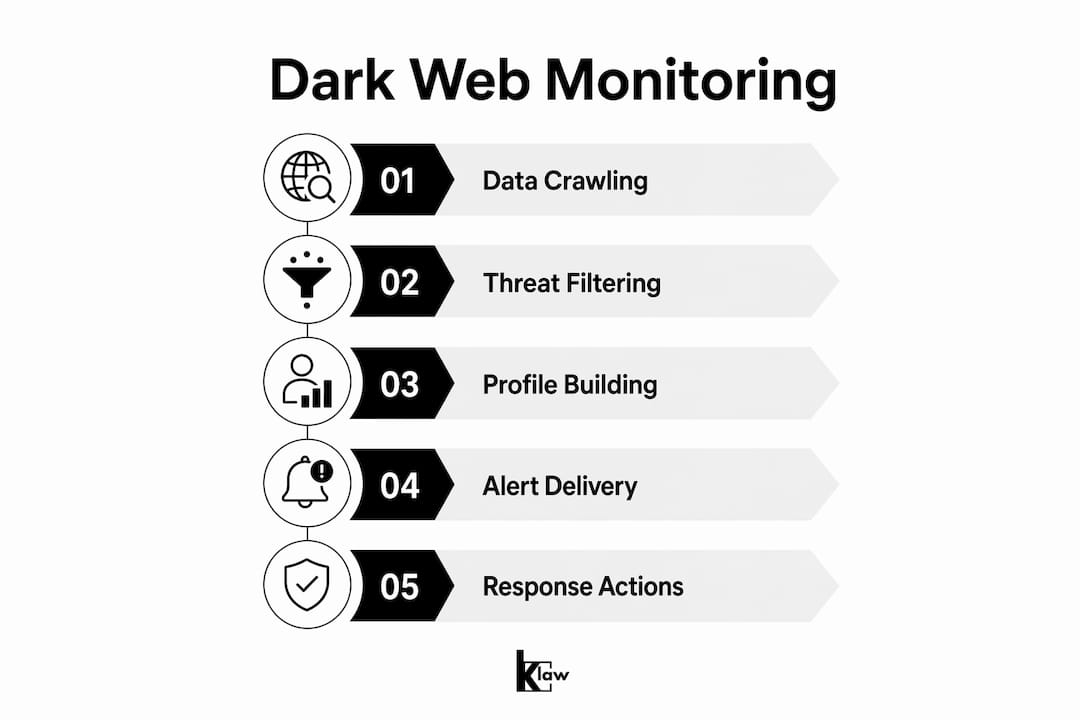
The collection and processing pipeline works in four steps:
- Crawling and collection. Automated bots continuously index publicly accessible Tor sites, paste sites, criminal forums, and dark web marketplaces. These crawlers run around the clock, pulling raw data as it appears.
- Normalization and deduplication. Raw data arrives messy and redundant. Tools clean it by standardizing formats, removing duplicate records, and stripping irrelevant noise before storing anything useful.
- Indexing and storage. Cleaned data gets indexed in searchable databases. This step makes real-time matching fast and reliable, even across billions of records.
- Matching against your assets. The tool compares indexed data against your registered assets, such as your email address, username, phone number, or company domain. A match triggers an alert.
AI-enabled systems achieve 98% accuracy in threat filtering. That number matters because earlier tools produced false positive rates above 90%, burying real threats in noise. One organization reduced a 1,500-hour manual investigation process to a single week by switching to automated collection and AI-assisted triage.
Modern tools also build dynamic profiles of your digital footprint autonomously. They adjust without manual keyword input, detecting implicit mentions of your data even when threat actors deliberately avoid using your exact name or email. This is a significant leap beyond simple keyword matching.

Pro Tip: When you set up any dark web scan, register every email address you actively use, including old ones. Breached credentials from accounts you forgot about are among the most common findings.
What types of threats do monitoring tools detect beyond passwords?
Most people assume dark web monitoring only catches leaked passwords. The actual scope is far broader. Comprehensive monitoring tools detect threats weeks before a formal breach is announced, and the categories go well beyond login credentials.
Here is what quality dark web security software actually tracks:
- Exposed credentials. Usernames, passwords, and session tokens sold in bulk on criminal marketplaces.
- API keys and source code. Leaked developer credentials give attackers direct access to systems and applications.
- Brand impersonation. Fake domains, spoofed social media accounts, and phishing kits built to mimic your identity or a company you work for.
- Executive exposure. Personal details about executives, including home addresses and travel patterns, that enable targeted social engineering or physical threats.
- Sensitive documents. Contracts, financial records, and internal communications that appear in data dumps.
- Supply chain risks. Credentials from third-party vendors that have access to your systems, which attackers exploit to reach you indirectly.
- Customer data. Stolen payment card numbers, account details, and personal records tied to businesses you interact with.
Many premium services also offer takedown partnerships for phishing domains, adding a remediation layer that goes beyond detection. If a fake version of your email domain is circulating, the tool can initiate removal rather than just notify you.
How do AI and human analysts improve monitoring effectiveness?
Automation handles volume. Human analysts handle context. The best dark web monitoring methods combine both, and neither works as well alone.
AI algorithms scan millions of data points and connect patterns across separate events. A credential appearing in one forum, combined with a phishing kit referencing your email domain in another, gets flagged as a coordinated threat rather than two unrelated findings. Google Threat Intelligence demonstrated 98% accuracy using this kind of AI-driven correlation, compared to previous tools that generated false positives on more than 9 out of 10 alerts.
Human analysts add the layer that AI cannot replicate: intent and context. Expert analysts validate automated findings, confirm whether a threat is active or recycled old data, and prioritize alerts by actual risk level. Many are fluent in multiple languages, which matters because significant portions of dark web activity occur in Russian, Chinese, Arabic, and Portuguese.
"The most critical intelligence often lives in invite-only chats and private groups that automated crawlers simply cannot reach." — SecurityListing
Restricted private forums require human intelligence teams to gain access. These spaces contain the highest-value, most actionable data, including early discussions of planned attacks and fresh credential batches before they are widely distributed. Automated tools alone miss this entirely.
Pro Tip: When evaluating any dark web security software, ask specifically whether the service uses human analysts or relies solely on automation. The answer tells you how much of the dark web they can actually see.
What are common misconceptions about dark web monitoring?
Dark web monitoring is not a complete security solution on its own. It works best as part of a unified digital risk management strategy, not as a standalone tool. Several misconceptions lead people to either over-rely on it or dismiss it prematurely.
- "If nothing is flagged, I am safe." Monitoring only catches data that surfaces in observable sources. Threats in private channels or newly formed groups may not appear immediately.
- "Every alert requires urgent action." Many alerts reference old, recycled data from breaches years ago. Without context about credential validity, alerts can be non-actionable and create unnecessary panic.
- "The tool handles everything automatically." Detection is automated. Response is not. You still need to reset passwords, enable multi-factor authentication, and follow up on each finding.
- "Real-time means instant." Indexing and matching take time. A breach that occurred today may not surface in monitoring results for hours or days, depending on how quickly the data circulates.
- "More alerts mean better protection." Alert fatigue is a real problem. Integrating monitoring with response workflows such as SIEM or SOAR systems turns raw alerts into prioritized tasks. Without that integration, volume becomes a liability.
The honest reality is that no tool catches every threat immediately. Monitoring dark web activity reduces your exposure window significantly, but it works best when paired with strong passwords, multi-factor authentication, and regular security reviews.
How can you act on dark web monitoring alerts effectively?
Receiving an alert is the beginning of the process, not the end. Here is a practical sequence for responding when monitoring tools flag your data:
- Verify the alert. Confirm whether the exposed data is current and whether the credentials are still active. Old breach data from 2019 requires a different response than a fresh credential dump from last week.
- Change the compromised credentials immediately. Use a password manager to generate a unique, strong replacement. Do not reuse any part of the old password.
- Enable multi-factor authentication. Add MFA to every account connected to the exposed email or username. This step alone blocks the majority of credential-based attacks.
- Check for account activity. Review login history on affected accounts for any unauthorized access that may have already occurred.
- Monitor for follow-on threats. A single exposed credential often leads to targeted phishing attempts. Stay alert to suspicious emails or messages in the days following an alert.
Automated forced password resets and session invalidations reduce the manual burden significantly. Tools that integrate with identity management systems can trigger these actions the moment a match is detected, cutting your response time from hours to minutes. For ongoing protection, a service like Klaw's dark web scan for personal data keeps your email and identity assets under continuous watch.
Key takeaways
Dark web monitoring tools work by continuously collecting data from underground sources, matching it against your personal assets, and alerting you in real time so you can respond before serious damage occurs.
| Point | Details |
|---|---|
| Automated collection pipeline | Tools crawl Tor sites, forums, and encrypted channels 24/7 and index findings for real-time matching. |
| AI accuracy advantage | AI-driven filtering achieves 98% accuracy, cutting false positives that plagued earlier monitoring tools. |
| Scope beyond passwords | Quality tools detect API keys, brand impersonations, executive exposure, and supply chain risks. |
| Human analysts fill the gap | Invite-only forums require human intelligence teams; automation alone misses the most critical threats. |
| Alerts require your response | Detection is automated, but resetting credentials and enabling MFA still depends on you acting promptly. |
Why I think most people are using dark web monitoring wrong
Most individuals set up a monitoring service, receive their first alert, and then do one of two things: they panic and change every password they own, or they dismiss the alert as old data and do nothing. Both responses miss the point entirely.
The real value of monitoring dark web activity is not in any single alert. It is in the pattern. When you track alerts over time, you start to see which of your email addresses is most exposed, which services you use have the worst breach records, and where your digital footprint is largest. That pattern tells you where to focus your security efforts, not just where to react.
I have also seen people treat a clean monitoring report as proof they are safe. That is the most dangerous misconception of all. Private forums and invite-only channels hold the freshest, most dangerous data, and automated tools simply cannot reach them. A clean report means nothing was found in observable sources. It does not mean nothing exists.
The right mindset is continuous and skeptical. Use monitoring as an early warning system, not a security certificate. Pair it with strong authentication practices, and treat every alert as a data point in a larger picture rather than an isolated emergency. That approach turns a reactive tool into a genuinely proactive one.
— Lucky
Stay ahead of threats with Klaw's dark web alerts
Klaw's Dark Web Alerts service gives you continuous monitoring across over 10,000 breach databases, with real-time notifications the moment your email or personal data surfaces on underground platforms. There are no hidden fees and no subscription traps. You get instant alerts, guidance on recovery steps, and automated data broker removals built into the same platform. For users who want an additional layer of privacy while monitoring their exposure, Klaw also offers a VPN dashboard to keep your online activity secure. Start with a free email scan and see exactly what is already out there.
FAQ
What does dark web monitoring actually scan?
Dark web monitoring scans Tor sites, criminal forums, paste sites, encrypted messaging channels, and dark web marketplaces for your personal data. Tools match findings against assets you register, such as email addresses, usernames, and phone numbers.
How fast do dark web monitoring tools send alerts?
Most tools deliver alerts within hours of a match, though detection speed depends on how quickly compromised data circulates after a breach. AI-enabled systems reduce this window significantly compared to manual monitoring methods.
Can dark web monitoring tools remove my data from the dark web?
Monitoring tools detect and alert; they do not delete data from criminal platforms. Some premium services offer takedown partnerships for phishing domains and impersonation sites, but stolen credentials already in circulation cannot be fully removed.
Is dark web monitoring worth it for individuals, not just companies?
Dark web monitoring benefits individuals directly because personal email addresses, passwords, and financial data are among the most commonly traded items on criminal marketplaces. Individual exposure is just as common as corporate breaches.
What should I do immediately after receiving a dark web alert?
Verify whether the exposed data is current, change the compromised password immediately using a unique replacement, and enable multi-factor authentication on every connected account. Review recent login activity to check for unauthorized access.