
TL;DR:
- Data breaches in 2026 are primarily caused by vulnerability exploitation, accounting for 31% of incidents. Human error and third-party risks significantly contribute, while AI accelerates attack timelines from months to hours. Regular updates, cautious behavior, and proactive monitoring can help individuals and organizations reduce breach risks.
Most people picture a data breach as a shadowy hacker typing furiously to crack a password. The reality in 2026 looks very different. Understanding how data breaches happen means confronting a more complex picture, one where AI-powered attackers exploit unpatched software faster than most organizations can respond, where trusted vendors become back doors, and where a single tap on a mobile phishing link can expose your entire identity. This article breaks down the real causes of data breaches, what's changed, and what you can do about it.
Table of Contents
- Key takeaways
- How data breaches happen: the 2026 breakdown
- The rise of vulnerability exploitation
- The human element: phishing, pretexting, and mobile scams
- Third-party and supply chain risks
- Data leaks versus breaches: the difference matters
- My take on why speed and habits matter more than tools
- Stay ahead of breaches with Klaw
- FAQ
Key takeaways
| Point | Details |
|---|---|
| Exploitation now leads breaches | Vulnerability exploitation is now the top breach cause, responsible for 31% of incidents in 2025. |
| Human error remains widespread | 62% of breaches involve a human element, from phishing clicks to misconfigured systems. |
| Third-party risk has surged | Nearly half of all confirmed breaches now involve a vendor or third-party provider. |
| AI shrinks the attack window | AI tools compress the time from vulnerability disclosure to active exploitation from months to hours. |
| Monitoring is your early warning | Scanning your email against breach databases can alert you before criminals weaponize your stolen data. |
How data breaches happen: the 2026 breakdown
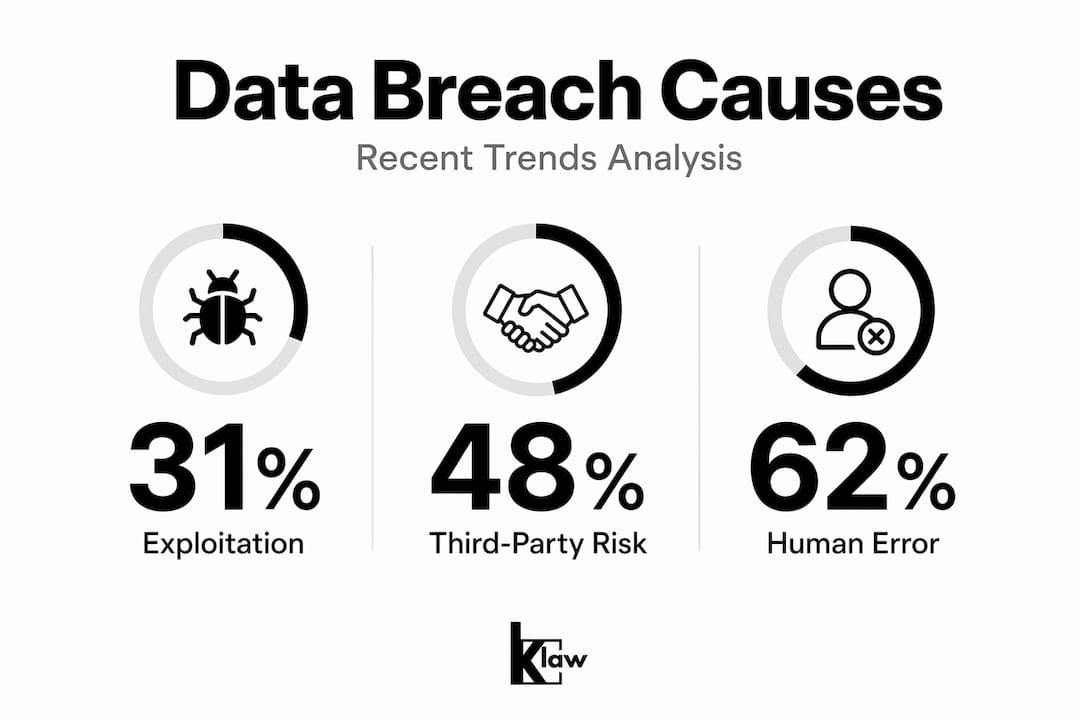
For years, stolen credentials held the top spot as the leading cause of data breaches. That changed. Vulnerability exploitation rose to 31% of all breaches in 2025, up from 20% in 2024, while stolen credentials fell to just 13%. The shift reflects how attackers now operate. They target flaws in software before organizations can fix them, moving through networks without ever needing a stolen password.
Here are the primary causes of data breaches based on 2025 and 2026 data:
- Vulnerability exploitation (31%): Attackers find and use unpatched software flaws to gain access.
- Stolen credentials (13%): Usernames and passwords obtained through prior breaches or phishing.
- Phishing and social engineering: Manipulation of people through deceptive emails, texts, and calls.
- Ransomware: Ransomware is involved in 48% of breaches, a rise from 44% the previous year.
- Third-party compromise: Trusted vendors and service providers used as entry points.
What triggers data breaches is rarely one single factor. A phishing email might deliver malware that exploits a software vulnerability, which then opens access to a third-party vendor's systems. The causes chain together. Understanding that chain is what separates people who respond early from people who find out months later when their data surfaces on the dark web.
One angle most people miss is the role of breach databases in personal security. Your email address may already appear in dozens of known breaches, each one giving attackers a foothold to start building a profile of you.
The rise of vulnerability exploitation
A software vulnerability is a flaw in code that, when left unpatched, creates an opening attackers can walk right through. Think of it like a cracked window in an otherwise locked building. The window was always there. The burglar just found it before the owner got around to fixing it.

The gap between finding a flaw and weaponizing it has collapsed. AI tools now compress that window from months to hours. Once a vulnerability is publicly disclosed, attackers scan the internet for exposed systems and launch exploit code almost immediately. Organizations, by contrast, often take weeks or months to respond.
| Metric | 2024 | 2025 |
|---|---|---|
| Vulnerability exploitation share | 20% | 31% |
| Median days to patch a flaw | ~32 days | 43 days |
| Critical vulnerabilities fully fixed | ~38% | 26% |
| Stolen credentials as breach cause | ~18% | 13% |
The numbers tell a stark story. The median time to patch vulnerabilities stretched to 43 days in 2025, while only 26% of known critical vulnerabilities were fully remediated. Attackers need hours. Defenders are taking over a month. That gap is where breaches live.
Effective breach prevention at the organizational level requires shifting to secure development practices that catch flaws early in the software lifecycle rather than scrambling to patch after release. For individuals, the parallel lesson is simpler: keep your apps, operating system, and devices updated. Every pending update is a window that might still be cracked.
Pro Tip: Turn on automatic updates for your phone, browser, and any apps connected to banking or email. You probably won't apply manual updates consistently, but automatic updates run whether you remember or not.
The human element: phishing, pretexting, and mobile scams
Technology can be patched. Human behavior is harder to fix. 62% of data breaches involved a human element in 2025, including social engineering attacks that trick people into handing over credentials or clicking malicious links. This is not a small footnote. It means well over half of all ways data leaks occur trace back to a person making a mistake.
Social engineering works because it exploits trust, urgency, and familiarity. A pretexting attack, for example, involves an attacker building a believable false scenario. They might call posing as IT support, claim your account is at risk, and ask you to verify your password. This kind of attack frequently precedes ransomware infections.
Mobile-based phishing deserves special attention. Mobile phishing attacks succeed 40% more often than email phishing. The reasons are practical. Smaller screens hide suspicious URLs. People read texts faster and with less scrutiny. Notification fatigue on mobile devices makes urgent-looking messages feel normal. A text that reads "Your bank account has been locked. Verify here:" gets tapped far more often than the same message in email form.
The most common human mistakes that contribute to breaches include:
- Clicking links in unexpected text messages or emails without verifying the sender
- Reusing the same password across multiple accounts
- Approving multi-factor authentication (MFA) requests without confirming the login attempt
- Connecting to public Wi-Fi without a VPN before accessing sensitive accounts
- Downloading apps from unofficial sources that request excessive permissions
Pro Tip: If you receive an unexpected MFA prompt you did not initiate, do not approve it. Contact the service directly through its official website. Approving unknown MFA requests is one of the fastest ways attackers gain account access.
Learning how to secure accounts after a password leak is something every person should understand before they need it, not after.
Third-party and supply chain risks
You might run your own security perfectly. It may not be enough. Third-party breaches now comprise 48% of all confirmed breaches, up from 30% in 2024. That is a 60% year-over-year increase. The services you rely on every day, your cloud storage, payroll software, shopping platforms, and apps, connect to your data even when you are not actively using them.
Attackers understand this. Rather than targeting a well-defended company directly, they compromise a smaller software vendor that the target company trusts. Misconfigured OAuth permissions or trusted vendor access can allow an attacker to inherit legitimate rights without ever cracking a password. It is access without intrusion, which is precisely why the data breach investigation process often takes so long to identify the original entry point.
Compliance checklists alone do not capture these blind spots. An organization can pass every audit requirement and still be exposed because a vendor's software had an unpatched flaw. Security professionals note this gap repeatedly, yet many organizations still treat compliance as a finish line rather than a floor.
For individuals, the lesson is to audit the apps and services connected to your accounts. Go through your Google, Apple, or Microsoft account and review which third-party apps have permission to access your data. Revoke access for services you no longer use. Every connected app is a potential entry point, even if you stopped using it two years ago.
Data leaks versus breaches: the difference matters
A breach involves someone forcing their way into a system. A data leak can happen without any intrusion at all. Leakage often occurs through authorized channels due to misconfigurations or insider misuse, and it can be significantly harder to detect than a forced breach. No alarm goes off because no one broke in.
Common ways data leaks occur from the inside include:
- A database misconfigured to be publicly accessible without a password
- An employee emailing sensitive files to a personal account for convenience
- A contractor accidentally uploading company documents to a shared cloud folder
- Authorized users exporting more data than their role requires
Shadow AI is an emerging and underappreciated leak source. 67% of users access AI services through non-corporate accounts, meaning sensitive work data gets fed into generative AI tools that are completely outside company monitoring. Employees paste customer data, internal documents, or source code into a consumer AI chatbot, and that data leaves the controlled environment entirely. Attackers also use low-and-slow exfiltration techniques that move data out gradually through legitimate-looking protocols, staying invisible to standard detection tools for weeks or months.
For individuals, the practical defense is awareness. Be cautious about which services store your personal information, and periodically check whether you have accounts on platforms you no longer monitor. Dormant accounts with personal data are leak risks waiting to be discovered.
My take on why speed and habits matter more than tools
I've watched the security conversation shift year after year toward technology. New tools, new platforms, better detection. And the breach numbers keep climbing. What I've learned is that the gap isn't in the tooling. It's in the time it takes to act on what you already know.
The shift from credential theft to exploitation isn't just a statistics story. It tells you that attackers are moving faster than the organizations defending against them. AI accelerates the attacker's side of that equation at a pace most security teams genuinely cannot match. Patching at 43 days when exploitation happens in hours is not a process problem. It's a structural gap that no compliance checklist will close.
What I think actually moves the needle for individuals is simpler and more personal. Stop treating security as a one-time setup. The people I've seen avoid the worst outcomes are not the ones with the most sophisticated tools. They are the ones who check their breach exposure regularly, update their software without waiting, and treat unexpected requests with suspicion rather than convenience. Those are habits, not products. The 2026 breach recovery guide offers useful frameworks, but habits built before a breach happen to be the only ones that actually prevent one.
The uncomfortable truth is that most data breaches are predictable. Not because the attackers telegraphed their moves, but because the conditions that allow breaches to succeed are consistently the same: slow patching, trusted but unmonitored access, and people making quick decisions under pressure. Addressing those conditions is less about spending money and more about paying attention.
— Lucky
Stay ahead of breaches with Klaw
Knowing how data breaches happen is only useful if you act on that knowledge. Klaw gives you the tools to monitor your exposure in real time, so you are not the last to know when your data is compromised.
With Klaw, you can scan your email against over 10,000 breach databases for free and receive instant alerts when your information surfaces somewhere it should not be. The Security Trend Dashboard keeps you current on emerging threats, while Threat Alert Settings let you customize exactly what you get notified about. For dark web monitoring, Dark Web Alerts watch for your credentials in places most people never think to look. If the worst happens, Klaw's incident response support walks you through recovery step by step. No hidden fees. No subscriptions you have to cancel.
FAQ
What is the most common cause of data breaches?
Vulnerability exploitation became the leading cause in 2025, responsible for 31% of breaches, surpassing stolen credentials which dropped to 13%.
How does social engineering lead to a data breach?
Attackers manipulate people through phishing emails, text messages, or phone calls to hand over credentials or click malicious links, which then grant access to systems or accounts.
What is the difference between a data breach and a data leak?
A breach involves unauthorized access by an external attacker, while a data leak occurs through authorized channels such as misconfigurations or insider misuse, often without any sign of intrusion.
How do I know if my data has been breached?
You can scan your email address against breach databases using a service like Klaw to check whether your information has appeared in any known data breaches.
How can I prevent my personal data from being exposed?
Enable automatic software updates, use unique passwords for every account, avoid tapping links in unexpected texts, and regularly audit which third-party apps have access to your accounts.