
TL;DR:
- Understanding breach reports involves identifying critical facts like breach dates, data involved, access versus exfiltration, and encryption status to accurately assess risk. Many notices use vague language and omit key details, requiring proactive verification and documentation for effective response. Prompt actions include changing passwords, enabling two-factor authentication, and contacting relevant agencies, especially when sensitive data like SSNs or financial information are compromised.
A data breach report is a formal document disclosing that unauthorized parties gained access to protected information, and reading one correctly is the difference between taking the right protective action and missing a serious threat entirely. Most people skim the headline, feel relieved or alarmed based on tone, and move on. That approach leaves real risk unaddressed. How to understand breach reports means knowing which specific fields to examine, what the legal language is hiding, and how to match the data types exposed to concrete protective steps. Tools like Have I Been Pwned, hashing algorithms, and credit freeze procedures all play a role in that process.
How to understand breach reports: the key components
Every breach report contains a set of facts that determine your actual risk. The challenge is that breach notices are legal documents designed to minimize liability, which means the most important details are sometimes buried or omitted entirely. Your job is to extract four core elements before drawing any conclusions.

Breach date vs. discovery date
The breach date is when the intrusion occurred. The discovery date is when the organization found out. These are almost never the same. Attacker dwell time between intrusion and disclosure can span months or even years, which means your data may have been circulating on criminal markets long before you received any notification. When you see a discovery date but no breach date, treat the exposure window as open-ended and act accordingly.
Data categories involved
Not all exposed data carries equal weight. A breach report should explicitly list the categories of information involved: email addresses, passwords, Social Security numbers, financial account details, health records, or physical addresses. Specific data categories and timing are the most critical fields for risk assessment, yet many notices collapse these into vague phrases like "personal information." If the report does not name the data types clearly, that absence is itself a red flag.
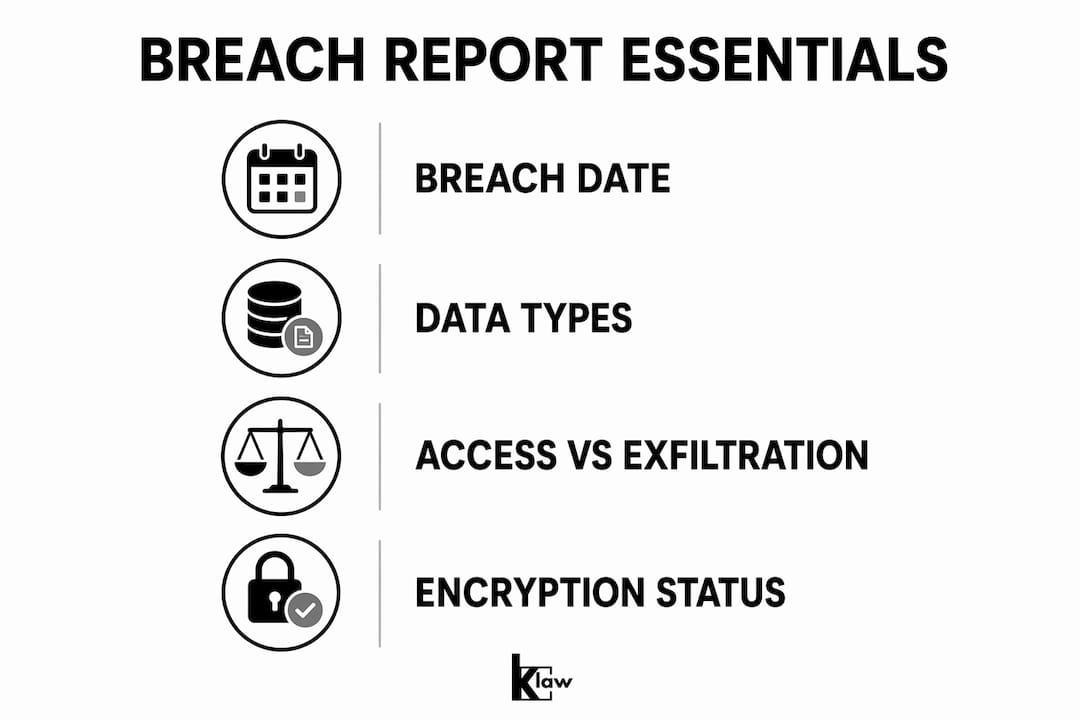
Accessed vs. exfiltrated
These two words carry very different implications. "Accessed" means an unauthorized party viewed or reached the data. "Exfiltrated" means they took it. Small businesses evaluating vendor breach notices should not assume "accessed" means no harm was done, but exfiltration signals a higher and more immediate risk for identity fraud and account takeovers. If the report does not specify which occurred, assume exfiltration until proven otherwise.
Encryption and hashing status
If passwords were stored using a strong hashing algorithm like bcrypt or Argon2, cracking them is computationally expensive and time-consuming. If they were stored in plain text or with a weak algorithm like MD5, they are effectively already compromised. Absence of hashing information in a breach notice means you should assume worst-case and change the affected password immediately, along with any other account where you reused it.
Pro Tip: Create a simple checklist with four fields: breach date, data types, access vs. exfiltration, and encryption status. Run every breach notice you receive through that checklist before deciding on a response.
How to interpret vague or ambiguous breach notifications
Corporate and legal teams write breach notifications to satisfy regulatory requirements while limiting reputational damage. The result is a genre of writing that is technically informative but practically opaque. Recognizing the patterns helps you cut through the noise.
Here are the most common red flags in breach notification language:
- "May have been accessed" signals uncertainty about scope, not absence of harm. Treat it as confirmed access.
- "Security incident" instead of "breach" is a deliberate word choice. Under laws like GDPR Article 33, a breach has specific legal meaning. Softer language avoids triggering that definition publicly.
- Missing breach dates prevent you from calculating attacker dwell time. If dates are absent, contact the organization directly and request them in writing.
- "Certain information" without specifying what categories were involved is a decision blocker. You cannot assess risk without knowing what data was exposed.
- No mention of encryption or hashing means the organization either does not know or does not want to say. Either scenario warrants a worst-case response.
HIPAA's breach notification rule requires covered entities to notify affected individuals within 60 days of discovery, and notifications must include breach type, impacted data, and protective steps. If a notice you receive omits those elements, the organization may be out of compliance, and you have grounds to request a complete disclosure.
Pro Tip: Send a written request to the organization's data protection officer or privacy team asking for the specific breach date range, the exact data fields involved, and whether data was exfiltrated. Keep a copy of your request and their response for your records.
What exposure risk levels do different data types represent?
Understanding security breaches requires a mental model for ranking risk. Not every breach demands the same response. Here is a practical risk ladder based on the data types involved.
| Data exposed | Risk level | Recommended action |
|---|---|---|
| Email address only | Low | Monitor for phishing; no urgent action required |
| Email plus password | Elevated | Change password immediately; enable authenticator-app 2FA |
| Email, password, and SSN | Severe | Credit freeze at Equifax, Experian, and TransUnion; fraud alert |
| Financial account details | Critical | Notify your bank; request new account numbers; monitor statements |
| Health records | High | Monitor for medical identity fraud; review insurance claims |
Exposure risk scales directly from email only at the lowest end to email plus password plus SSN and financial data at the severe end, with password hashing details modifying the actual takeover risk at each level. An email address alone enables phishing attacks but not account takeovers. A plaintext password paired with an email address gives an attacker direct access to every account where you reused that combination.
The timing and exfiltration status also shift the urgency. A breach discovered the same week it occurred, with no evidence of exfiltration, allows more time for measured response. A breach discovered six months after the intrusion, with confirmed exfiltration of financial data, demands immediate action across every linked account.
What steps should you take after reviewing a breach report?
Once you have extracted the key facts from a breach report, the response follows a clear sequence. Here is the prioritized order for both individuals and small business owners.
- Change the compromised password immediately. Use a unique, randomly generated password for the affected account. Password managers like Bitwarden or 1Password generate and store these automatically.
- Enable authenticator-app 2FA. SMS-based two-factor authentication is better than nothing, but authenticator apps like Google Authenticator or Authy are significantly harder to intercept. Standard immediate steps include this alongside password changes as the first line of defense.
- Check for unauthorized logins. Most major platforms show recent login history. Review it for unfamiliar locations or devices and revoke any active sessions you do not recognize.
- Freeze your credit if SSN or financial data was exposed. Contact Equifax, Experian, and TransUnion directly. A credit freeze is free and prevents new accounts from being opened in your name.
- Notify your bank if financial data was involved. Request account monitoring alerts and ask whether new account numbers are warranted.
- Use Have I Been Pwned to check your email address against known breach databases. This gives you a broader picture of your exposure history, not just the single breach you received notice about.
For small business owners, the response extends further. Review your data breach recovery steps to determine whether you have downstream notification obligations to customers or partners. Document every communication you receive and send regarding the breach. If a vendor breach exposed customer data you hold, you may have legal notification requirements under state laws or GDPR Article 33.
- Audit which third-party vendors have access to your customer data.
- Review contracts for breach notification clauses and response timelines.
- Consider whether your cyber liability insurance covers the incident.
- Update your internal incident response plan based on what the breach revealed.
Key takeaways
Breach report analysis requires extracting four specific facts: breach date, data categories, access versus exfiltration status, and encryption details. Without all four, you cannot accurately assess your risk or prioritize your response.
| Point | Details |
|---|---|
| Extract four core fields | Always identify breach date, data types, access vs. exfiltration, and encryption status before responding. |
| Treat vague language as a red flag | Missing dates or data categories in a notice mean you should contact the organization and assume worst-case. |
| Risk scales with data type | Email alone is low risk; SSN or financial data exposure requires immediate credit freezes and bank alerts. |
| Act on attacker dwell time | The breach may have occurred months before notification, so protective steps should not wait for more disclosure. |
| Document everything | Keep copies of all breach communications and your responses for potential disputes or insurance claims. |
Why most people misread breach reports and what to do instead
The most common mistake I see is treating the headline severity label as the actual risk assessment. A notice that says "low severity" may still contain a plaintext password exposure. A notice that says "we take your security seriously" tells you nothing about what data was taken or when. Security analysts prioritize contextual evidence over alert titles, and the same discipline applies to reading breach notices.
What actually works is building a personal exposure matrix. For every breach you receive notice about, log the organization, the breach date range, the data types confirmed, the encryption status, and the actions you took. Over time, this gives you a clear picture of your cumulative exposure, not just isolated incidents. It also becomes useful documentation if you ever need to dispute a fraudulent account or file an insurance claim.
The detail most people underestimate is attacker dwell time. If a breach occurred in January and you received notice in August, an attacker had seven months with your credentials. That window matters enormously for assessing whether fraud has already occurred versus whether you are preventing future harm. The implied attacker timeline should guide your response, not the notification date.
My strongest recommendation: do not wait for a breach notice to start monitoring. Proactive scanning against breach databases and dark web monitoring catches exposure before the organization even sends you a letter. By the time you receive a formal notification, the data has often been circulating for months.
— Lucky
Stay ahead of breaches with Klaw
Reading a breach report is reactive by nature. You receive a notice, decode it, and respond. Klaw shifts that equation by giving you early warning before the formal notice arrives.
Klaw's Dark Web Alerts scan over 10,000 breach databases and notify you the moment your credentials appear in a new exposure. The Data Broker Optouts service automatically removes your personal information from data broker listings, reducing the amount of data available to attackers in the first place. The Security Trend Dashboard tracks emerging threats in real time so you know which breach types are active right now. No hidden fees, no subscriptions you forget about. Just clear, continuous protection for individuals and small businesses who take their exposure seriously.
FAQ
What is the first thing to look for in a breach report?
Identify the breach date, the specific data categories involved, whether data was accessed or exfiltrated, and the encryption status of any passwords. These four fields determine your actual risk level and the urgency of your response.
What does "may have been accessed" mean in a breach notice?
It is legal language that signals uncertainty about the scope of the breach, not confirmation that no harm occurred. Treat it as confirmed access and take protective steps immediately rather than waiting for clarification.
When should I freeze my credit after a breach?
Freeze your credit at Equifax, Experian, and TransUnion any time a breach exposes your Social Security number or financial account details. A credit freeze is free and prevents new accounts from being opened in your name.
How do I check if my email was in other breaches?
Use Have I Been Pwned to search your email address against a large database of known breaches. This gives you a broader view of your cumulative exposure beyond any single notification you receive.
Do small businesses have legal obligations after a vendor breach?
Yes. If a vendor breach exposed customer data your business holds, you may have notification obligations under state breach laws or GDPR Article 33, which requires notifying authorities within 72 hours of discovery. Review your contracts and consult your legal counsel promptly.