
TL;DR:
- Credential stuffing is an automated cyberattack that tests stolen, reused credentials across multiple sites, causing widespread account breaches. It leverages low-volume, distributed attempts mimicking normal behavior, making detection difficult without advanced analytics. Using passkeys, unique passwords, and continuous breach monitoring significantly strengthens defenses against this growing threat.
Credential stuffing is an automated cyberattack where criminals use stolen username and password pairs to break into accounts at scale, exploiting the fact that most people reuse passwords across multiple sites. According to research, credential stuffing caused the initial access in 22% of breaches reviewed in the Verizon 2025 DBIR, making it one of the most common entry points attackers use today. Tools like OpenBullet let attackers test millions of stolen credentials against login pages automatically, without writing a single line of custom code. The financial and personal consequences range from drained bank accounts to hijacked email and social media profiles. Understanding how this attack works is the first step toward stopping it.
What is credential stuffing explained, step by step
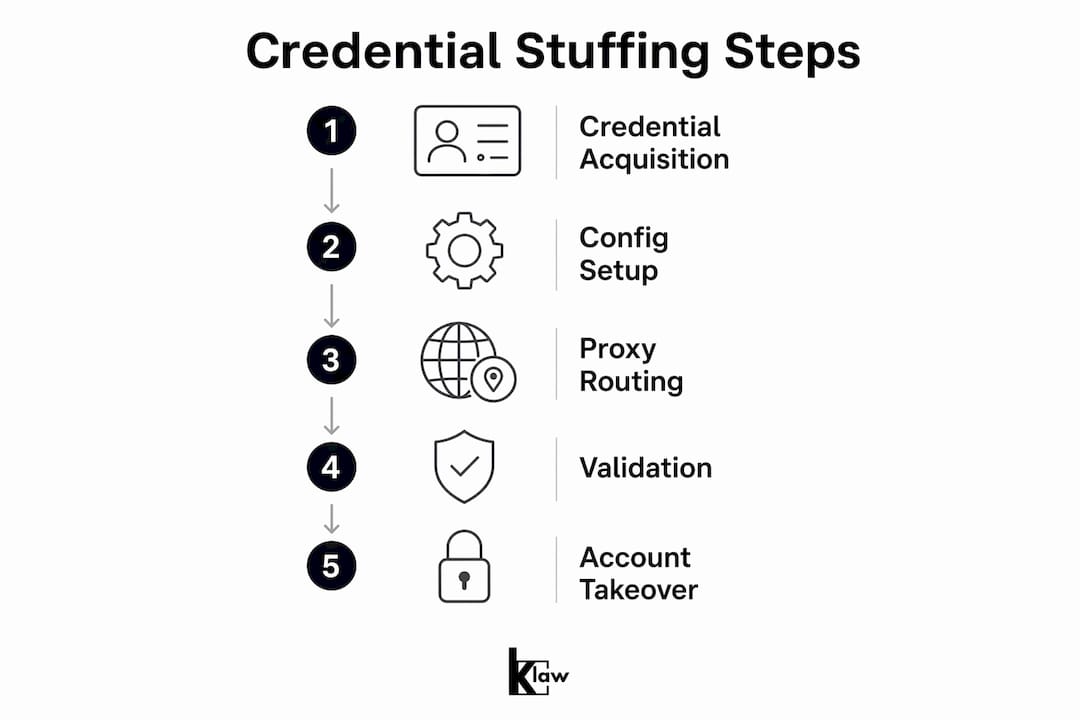
Credential stuffing is the automated testing of stolen login credentials against websites and apps to find accounts where the same password was reused. The industry term for the broader category is account takeover fraud, and credential stuffing is its most scalable form. Here is exactly how an attack unfolds.
Step 1: Credential acquisition. Attackers buy or download breach dumps from dark web marketplaces, forums, or Telegram channels. They also harvest fresh credentials using infostealer malware like RedLine or Raccoon, which packages stolen passwords and session cookies for sale within hours of infection. 244 million infostealer-sourced passwords were added to a major breach database in a single recent update, showing how fast the supply grows.
Step 2: Config setup. Attackers load their credentials into a tool like OpenBullet alongside site-specific "configs." Configs are shared scripts that define exactly how to interact with a target site's login form, including where to submit credentials and how to read success or failure responses. These configs circulate freely in attacker forums, meaning someone with no technical background can launch a large-scale attack against Netflix, Spotify, or a bank within minutes.
Step 3: Proxy routing. To avoid IP blocks, attackers route traffic through proxy networks. Residential proxies route attack traffic through real consumer devices, making each login attempt look like it comes from a different legitimate household. This is what separates credential stuffing from older brute-force attacks, which were easy to block by banning a single IP address.

Step 4: Validation and takeover. The tool runs through the credential list, flagging successful logins. Attackers then drain loyalty points, make fraudulent purchases, sell verified account access, or use the compromised email to reset passwords on other services.
Pro Tip: Credential stuffing differs from brute force (guessing random passwords) and password spraying (trying one common password across many accounts). Credential stuffing uses real, verified pairs, which is why success rates reach between 0.1% and 4% per credential set, far higher than random guessing.
What makes credential stuffing attacks so hard to detect
The stealth of a credential stuffing attack comes from how closely it mimics normal user behavior. Unlike a brute-force attack that hammers one account with thousands of guesses, credential stuffing spreads attempts across millions of accounts and hundreds of IP addresses simultaneously.
- Low attempt volume per account. Each site receives a low volume of attempts distributed over time and across IPs, so no single account triggers a lockout threshold.
- Residential proxy evasion. Because traffic originates from real home internet connections, IP reputation filters struggle to distinguish attackers from genuine users.
- Fresh credential supply. Infostealer malware harvests passwords and session cookies and packages them for sale within hours, meaning attackers constantly cycle in credentials that have not yet been flagged or changed.
- Session cookie theft. Even when a user has MFA enabled, attackers who steal a valid session cookie can bypass the authentication step entirely, since the server already considers that session authenticated.
- Misidentification risk. Misidentifying all failed login spikes as credential stuffing is a common security pitfall. Not every spike in login failures is an attack. Confusing routine user errors with an active attack leads to incorrect responses, like locking out real customers while the actual attack continues undetected.
"The most dangerous credential stuffing campaigns are the ones that never trigger a single alert. They move slowly, blend in, and only become visible after accounts are already compromised."
The shift toward infostealer malware as the primary credential source has made the threat faster and harder to contain. Where breach dumps from years-old hacks were once the main fuel, attackers now operate on near-real-time stolen data, narrowing the window between infection and account takeover to hours.
How to protect yourself against credential stuffing attacks
Personal protection against credential stuffing comes down to eliminating password reuse and adding authentication layers that stolen passwords cannot bypass.
Use a password manager. Tools like 1Password, Bitwarden, or Dashlane generate and store a unique, random password for every account. When every site has a different password, a breach at one service cannot unlock any other. This single change eliminates the core condition that makes credential stuffing effective.
Enable passkeys wherever possible. Passkeys replace passwords with cryptographic keys tied to your device, making stolen password lists completely useless for authentication. Google, Apple, and Microsoft all support passkeys today. Switching to a passkey on your Google account means that even if your old password appears in a breach dump, it cannot be used to log in.
Choose strong MFA methods. Passkeys and hardware security keys offer the strongest resistance, especially against session cookie theft bypasses. Authenticator apps like Google Authenticator or Authy are a solid baseline. SMS codes are better than nothing but are vulnerable to SIM-swapping attacks, so treat them as a last resort. You can learn more about setting up strong authentication through enterprise-grade 2FA guidance that applies equally to personal accounts.
Monitor your email addresses for breaches. Services like Have I Been Pwned let you check whether your credentials appear in known breach databases. Klaw goes further by scanning your email against over 10,000 breach databases and sending real-time alerts when new exposure is detected, giving you time to act before attackers do.
Recognize the signs of account takeover. Unexpected password reset emails, login notifications from unfamiliar locations, or purchases you did not make are all indicators that a credential stuffing attack may have succeeded. If you see these signs, change the password immediately, revoke all active sessions, and check whether the same password was used elsewhere. Klaw's guide on securing accounts after exposure walks through the exact recovery steps.
Pro Tip: Check your email on Have I Been Pwned right now. If any result shows "Pwned," treat every account that shares that password as compromised and rotate credentials immediately.
How organizations detect and counter credential stuffing attacks
Websites and security teams use layered defenses because no single control stops credential stuffing on its own. Here is how the most effective organizational defenses work.
| Defense layer | How it works | Limitation |
|---|---|---|
| IP reputation filtering | Blocks known malicious VPN and proxy IP ranges | Blocks 40-60% of attack traffic but misses residential proxies |
| Behavioral analytics | Flags abnormal login velocity, device fingerprints, and geography shifts | Requires tuning; can generate false positives |
| CAPTCHA and adaptive challenges | Interrupts automated login flows with human verification steps | Sophisticated bots and CAPTCHA-solving services can bypass standard implementations |
| Credential monitoring | Checks submitted passwords against known breach databases in real time | Only catches credentials already in public dumps |
| Risk-based authentication | Requires step-up verification when login context looks suspicious | Adds friction for legitimate users in edge cases |
Behavioral analytics is where the most progress is happening. Modern systems track hundreds of signals per login attempt, including typing cadence, mouse movement, device orientation, and the time between form fields. A bot filling in a login form in 0.3 seconds with no mouse movement stands out clearly against a human taking 4 to 8 seconds with natural cursor paths.
The residential proxy problem remains the hardest to solve. Because residential proxies route traffic through real consumer devices, IP reputation scores are often clean. Organizations that rely solely on IP blocking will miss a significant portion of attacks. Layering behavioral analytics on top of IP filtering is the approach that consistently outperforms either control alone.
Understanding how data breaches happen also helps security teams trace the upstream source of the credentials being used against them, which can inform faster incident response.
Key takeaways
Credential stuffing succeeds because password reuse is widespread, stolen credentials are cheap, and attacks are designed to look exactly like normal login traffic.
| Point | Details |
|---|---|
| Definition | Credential stuffing is automated account takeover using stolen username and password pairs. |
| Attack scale | Credential stuffing caused initial access in 22% of breaches in the Verizon 2025 DBIR. |
| Core defense | Passkeys and unique passwords per site eliminate the conditions credential stuffing exploits. |
| Detection challenge | Low-volume, distributed attempts mimic legitimate logins, making detection without behavioral analytics unreliable. |
| Personal action | Monitor your email in breach databases and enable the strongest MFA your accounts support. |
Why passkeys are the answer most people are ignoring
I have tracked credential-based attacks for years, and the pattern that stands out most in 2026 is the speed at which infostealer malware has changed the threat. Breach dumps used to be old news by the time attackers bought them. Now, credentials stolen this morning can be tested against your bank account by this afternoon. That compression of the attack timeline changes everything about how you need to respond.
The conventional advice to "use a strong password" is no longer sufficient on its own. A strong, unique password is still better than a weak one, but it is still a password. It can be phished, stolen by malware, or captured in a breach. Passkeys are different because they cannot be phished and they cannot appear in a breach dump. The private key never leaves your device.
What frustrates me is how few people have made the switch despite passkeys being available on Google, Apple, and Microsoft accounts for over a year. The setup takes under two minutes. The protection is categorically better. The barrier is not technical. It is awareness.
The other misconception I see constantly is the belief that MFA makes an account untouchable. Session cookie theft bypasses MFA entirely. If an infostealer grabs your active session cookie, the attacker walks straight into your account without ever entering a password or a one-time code. This is why monitoring for breach exposure and rotating sessions after any suspected compromise matters as much as the authentication method itself.
Prioritize passkeys first, then a password manager, then a hardware key or authenticator app for anything that does not yet support passkeys. That stack covers the vast majority of real-world credential stuffing scenarios. Check the role of breach databases in your personal security posture. Continuous monitoring is not paranoia. It is the only way to know when your credentials have already been compromised.
— Lucky
Stay ahead of credential threats with Klaw
Credential stuffing attacks succeed fastest against people who do not know their passwords are already circulating on the dark web. Klaw scans your email against over 10,000 breach databases for free, so you know your exposure before an attacker acts on it. Set up dark web alerts to get notified the moment your credentials appear in a new breach, giving you the window to change passwords and lock down accounts before damage occurs. Run a free breach scan today to see exactly which of your accounts are currently at risk. Klaw also provides automated data broker removals and VPN access, so your defense does not stop at monitoring.
FAQ
What is the credential stuffing definition in simple terms?
Credential stuffing is an automated cyberattack where stolen username and password pairs are tested against multiple websites to find accounts where the same password was reused. It is a form of account takeover fraud that scales because most people use the same password on more than one site.
How does credential stuffing differ from phishing?
Phishing tricks a user into handing over their credentials directly through a fake login page or deceptive email. Credential stuffing uses credentials already stolen from a previous breach and tests them automatically, with no interaction required from the victim.
Is credential stuffing a serious threat in 2026?
Credential stuffing was the initial access vector in 22% of breaches reviewed in the Verizon 2025 DBIR, making it one of the most active attack types targeting individuals and organizations today.
Can multi-factor authentication stop credential stuffing?
Standard MFA significantly raises the barrier, but attackers who steal active session cookies via infostealer malware can bypass it entirely. Passkeys and hardware security keys offer the strongest protection because they are cryptographically tied to your device and cannot be phished or replicated.
How do I know if my credentials have been used in a credential stuffing attack?
Signs include unexpected login alerts, password reset emails you did not request, or unfamiliar account activity. Proactively checking your email on Have I Been Pwned or using Klaw's free scan tool tells you whether your credentials are already in circulation before an attack succeeds.