
TL;DR:
- Data breach notification laws require organizations to promptly inform affected individuals and regulators when personal data is compromised, with requirements varying significantly across states and federal sectors. The discovery date typically triggers notification deadlines, which can range from 30 to 60 days, depending on jurisdiction, and organizations must carefully map their data to comply effectively. Proactive planning, documentation, and utilizing tools like breach detection dashboards help entities manage compliance and reduce legal and reputational risks.
Data breach notification law is a legal requirement that mandates organizations notify affected individuals and relevant authorities when personal data is compromised in a security incident. No single nationwide US law governs this — instead, a patchwork of 50 state laws plus sector-specific federal rules like HIPAA and SEC Regulation S-P creates one of the most complex compliance environments in American law. If your data has been exposed, or your business holds customer data, understanding these rules is not optional. It is the foundation of your legal and ethical obligation.
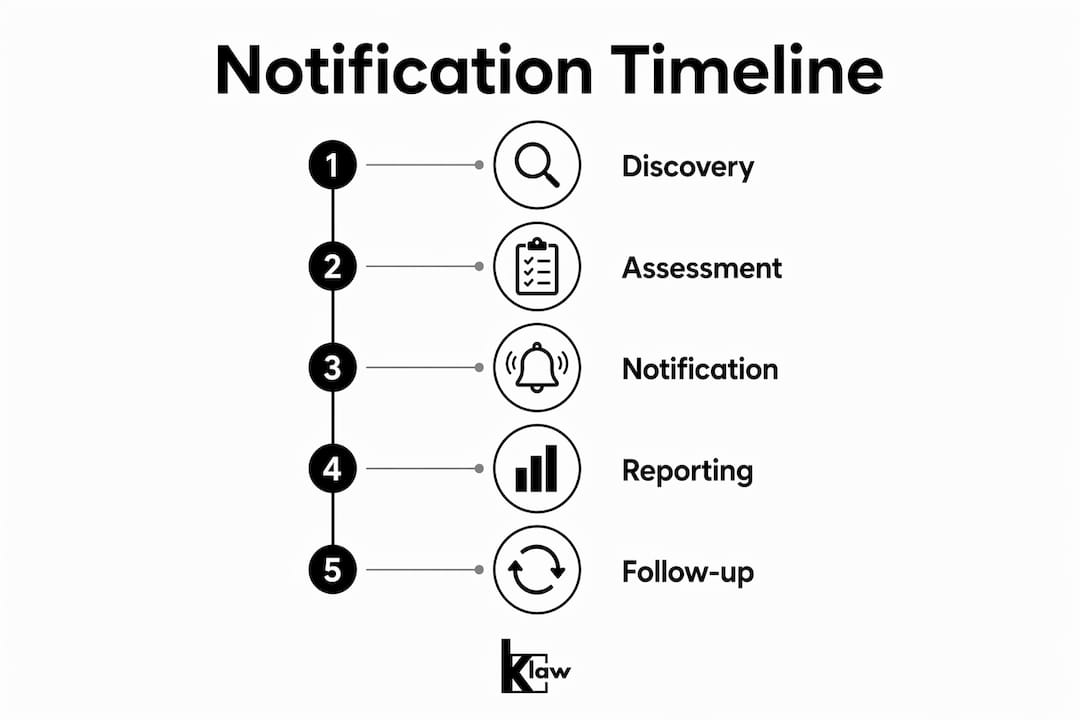
What is data breach notification law and what triggers it?
A data breach, in legal terms, is the impermissible acquisition, access, use, or disclosure of personal information in a way that compromises its security or privacy. Not every privacy incident qualifies. Unintentional access within a workforce, situations where the recipient cannot retain the information, or disclosures that fall within authorized use boundaries may not trigger notification duties. The distinction matters because premature or unnecessary notifications can create confusion, while delayed notifications can result in regulatory penalties.
The types of personal information that trigger notification requirements include:
- Personally identifiable information (PII): Full name combined with Social Security numbers, driver's license numbers, or financial account numbers
- Medical and health data: Protected health information (PHI) under HIPAA, including diagnoses, treatment records, and insurance details
- Biometric data: Fingerprints, retina scans, facial recognition data, and voiceprints
- Login credentials: Usernames and passwords, especially when linked to financial or government accounts
- Encrypted data: Some states require notification even when encrypted data is exposed, depending on whether the encryption key was also compromised
Most state laws apply to any business that collects or stores data on residents of that state, regardless of where the business is physically located. A company headquartered in Texas that holds data on California residents must comply with California's notification rules. This extraterritorial reach is one of the most misunderstood aspects of data breach law requirements.
Pro Tip: If your organization operates across multiple states, map your customer data by state of residence before a breach occurs. Knowing which laws apply in advance cuts response time dramatically when every hour counts.

How do notification requirements vary across states and federal sectors?
The variation across jurisdictions is significant. Twenty states use numeric deadlines ranging from 30 to 60 days, while 31 states rely on qualitative language like "expedient" or "without unreasonable delay." This means the same breach could trigger a hard 30-day clock in one state and a judgment-based standard in another. The table below captures the key differences across major jurisdictions and federal sectors.
| Jurisdiction / Sector | Notification deadline | Regulator notification | Key distinction |
|---|---|---|---|
| California (SB 446, 2026) | 30 days to individuals | 15 days to AG if 500+ affected | Strictest state deadline in the US |
| New York (2024 amendment) | 30 days from discovery | NYDFS plus other agencies | Fixed outer limit replaces vague language |
| HIPAA (federal, health) | 60 days from discovery | HHS and media for large breaches | Clock starts at discovery, not investigation end |
| SEC Regulation S-P | 30 days after determining access | SEC and FINRA | Applies even when misuse is only "reasonably likely" |
| Most other states | 30 to 60 days or qualitative | AG or state agency in 36 states | Definitions and covered data vary widely |
California's SB 446 effective 2026 represents the most aggressive state-level update in recent years. It requires notification to affected residents within 30 days and a separate 15-day notice to the California Attorney General when more than 500 residents are affected. This dual-track obligation is new and catches many compliance teams off guard.
New York's 2024 amendment is equally significant. Effective December 24, 2024, the law mandates notification within 30 days of discovery and adds the New York Department of Financial Services (NYDFS) to the list of required regulatory recipients. Courts and regulators are increasingly moving toward fixed outer limits like this to reduce the ambiguity that qualitative language creates.
On the federal side, HIPAA's 60-day rule applies to covered entities and business associates handling protected health information. The clock starts at the moment of discovery, not when forensic analysis is complete. For financial firms, SEC Regulation S-P amendments require customer notification within 30 days of determining that unauthorized access to sensitive customer information occurred, and the standard is "reasonably likely" harm, not confirmed misuse.
Pro Tip: Law enforcement exceptions exist in most state laws, allowing organizations to delay notification if a law enforcement agency determines that disclosure would impede a criminal investigation. Document these requests carefully and in writing.
What practical steps should businesses and individuals take?
Translating legal requirements into operational reality requires a structured approach. The following steps apply whether you are a compliance officer at a mid-size company or an individual who just received a breach notification letter.
-
Determine the discovery date immediately. Under HIPAA and most state laws, the notification clock starts at discovery, not at the conclusion of your investigation. Preparing notification drafts and internal workflows early is critical because waiting for a full forensic report before drafting notices is one of the most common and costly compliance mistakes.
-
Identify which laws apply. Determine the states where affected individuals reside and which federal sector rules (HIPAA, SEC Reg S-P, FTC Safeguards Rule) apply to your organization. A data breach disclosure guide can help map these obligations before a crisis hits.
-
Notify affected individuals through approved methods. Most laws permit written notice by mail, email (with prior consent), or telephone. When contact information is unavailable or the cost of direct notice is prohibitive, substitute notice through website posting or statewide media is allowed under many state laws.
-
Notify regulators, not just consumers. Thirty-six states require notifying the Attorney General or another state agency in addition to affected individuals. Federal rules like HIPAA require reporting to the Department of Health and Human Services, and breaches affecting 500 or more individuals in a state require media notification as well. Breach notification is more than consumer letters. It includes agency filings and, in many states, submission through public online portals.
-
Document everything. Record the date of discovery, the scope of the breach, the notification timeline, and every regulatory submission. This documentation is your primary defense in any regulatory investigation or civil lawsuit.
-
Take protective action if you are an individual. If you receive a breach notification, place a fraud alert or credit freeze with Equifax, Experian, and TransUnion immediately. Review the steps to secure accounts after any credential exposure and monitor your financial accounts for unusual activity.
One critical mistake organizations make is waiting to notify until every affected individual is identified. Many laws require notification as soon as a breach is discovered or eligibility is determined, not after the full scope is known. Delaying notification while waiting for a complete victim list is a compliance violation in most jurisdictions.
What recent updates are shaping breach notification law in 2026?
2026 is a pivotal year for data breach reporting rules. California's SB 446 introduced the first hard numeric deadline in the state's history, replacing the previous "expedient" standard with a 30-day clock. This shift reflects a broader national trend toward fixed deadlines and away from ambiguous qualitative language.
New York's 2024 amendment, now fully in effect, adds NYDFS to the list of required notification recipients. This matters because NYDFS has its own cybersecurity regulation (23 NYCRR 500) with separate incident reporting requirements, meaning financial firms operating in New York now face overlapping but distinct notification obligations under two separate frameworks.
For smaller financial entities, the SEC Regulation S-P amendments take effect June 3, 2026. These firms must now notify customers within 30 days of determining that unauthorized access to sensitive data occurred. The "reasonably likely" harm standard means notification must proceed in parallel with the investigation, not after it concludes. Under complex sector rules like SEC Reg S-P, parallel notification and investigation is now the expected standard.
States are also making breach reports more publicly accessible. Several states now publish breach notification filings in searchable online databases, which increases accountability for organizations but also means that breach disclosures become part of the public record. This transparency trend is accelerating, and organizations that treat notification as a legal checkbox rather than a communication responsibility will face growing reputational consequences alongside regulatory ones.
The broader direction of travel is toward harmonization. Advocacy groups and industry coalitions have pushed for a federal standard for years, but the 50-state variability remains the reality in 2026. Until a federal law preempts state rules, compliance teams must maintain jurisdiction-specific playbooks.
Key takeaways
Data breach notification law requires organizations to notify affected individuals and regulators promptly after a breach, with timelines, covered data, and regulatory recipients varying significantly by state and federal sector.
| Point | Details |
|---|---|
| No single federal law governs breaches | Organizations must comply with up to 50 state laws plus sector rules like HIPAA and SEC Reg S-P. |
| Discovery starts the clock | Notification deadlines begin at discovery, not at the end of forensic investigation, in most jurisdictions. |
| Regulators must be notified too | Thirty-six states require AG or agency notification in addition to consumer letters and public portal filings. |
| 2026 brought stricter deadlines | California's SB 446 and SEC Reg S-P amendments introduced hard numeric deadlines replacing vague language. |
| Individuals have immediate options | Fraud alerts, credit freezes, and account monitoring are the first protective steps after receiving a breach notice. |
Why the complexity of breach notification law is actually your advantage
Most people treat data breach notification law as a burden. I think that framing is wrong, and it leads to the worst compliance outcomes I have seen.
The organizations that struggle most are the ones that treat notification as a legal formality to be handled after the crisis is contained. The ones that navigate it well treat the notification framework as a forcing function for preparedness. When you have jurisdiction maps, notification templates, and regulator contact lists ready before a breach occurs, the 30-day clock becomes manageable. When you do not, it becomes a disaster.
The part that surprises most people is how much of the compliance work has nothing to do with the breach itself. It is about documentation, workflow, and knowing which regulator gets which form by which date. A security incident playbook built before a breach is worth more than any legal retainer you hire after one.
The other thing I would push back on is the assumption that these laws only matter to large enterprises. A small business holding 2,000 customer email addresses and payment details in three states has real notification obligations. The penalties for non-compliance scale with the violation, not the company size, in most jurisdictions.
The complexity of these laws is not going away. But it is navigable if you treat it as a planning problem rather than a legal emergency.
— Lucky
How Klaw helps you stay ahead of breach notification deadlines
Knowing a breach happened is the first requirement for meeting any notification deadline. Klaw's Security Trend Dashboard gives you real-time visibility into threat patterns affecting your data, so you are not discovering a breach weeks after it occurred. The dashboard aggregates signals across breach databases and dark web sources, giving you the earliest possible discovery date, which is exactly what the law requires you to document.
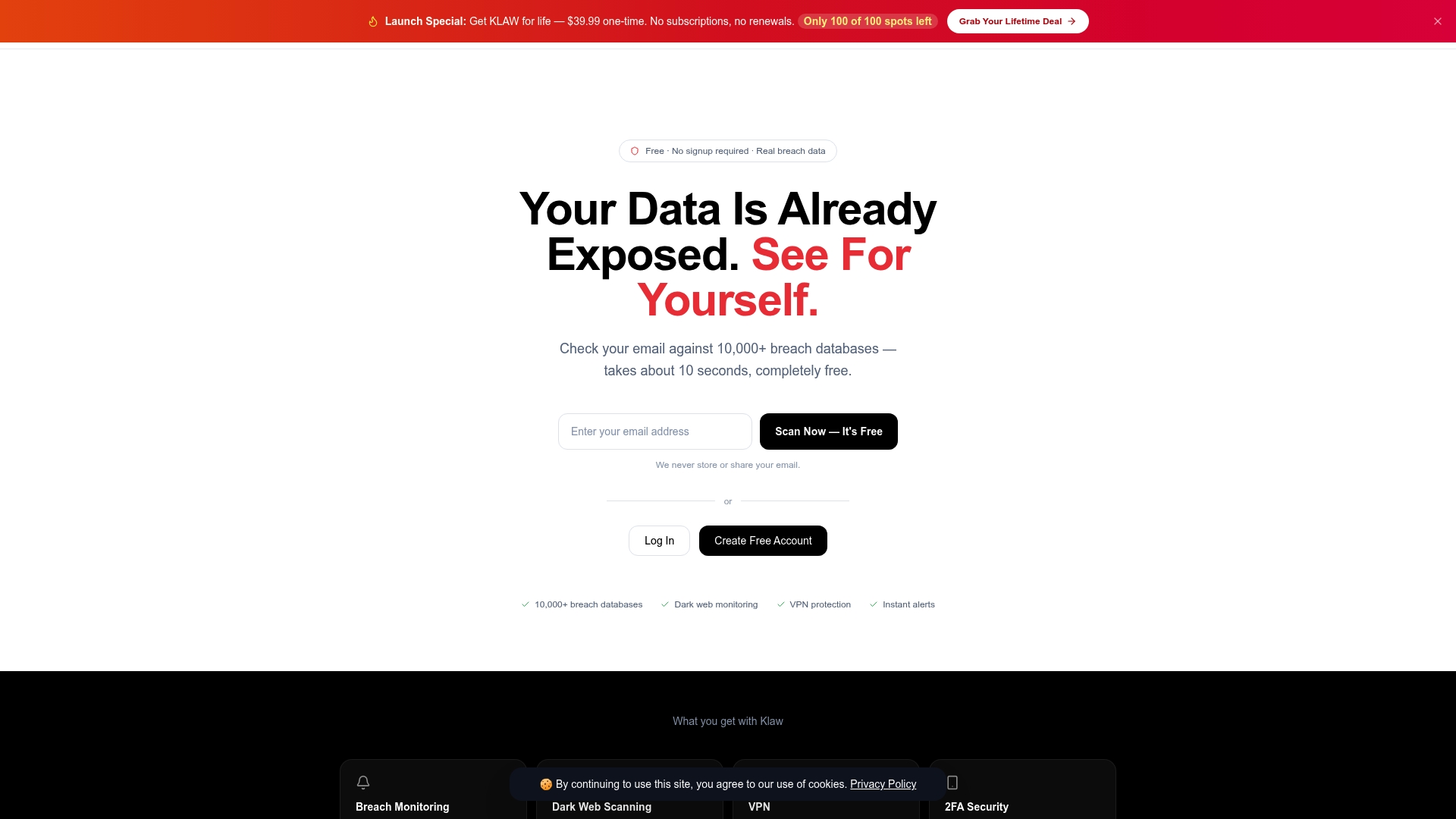
Klaw's Dark Web Alerts service monitors compromised credential markets and breach forums, sending instant notifications when your data appears. For individuals, this means knowing your information is exposed before identity thieves act on it. For businesses, it means the discovery clock starts when it should, not weeks later when a customer reports fraud. Klaw scans against over 10,000 breach databases at no cost, with no hidden fees or subscriptions.
FAQ
What is a data breach notification law?
A data breach notification law is a legal requirement mandating that organizations notify affected individuals and, in many cases, government regulators when personal data is compromised in a security incident. The US has no single federal law; instead, 50 state laws plus sector rules like HIPAA and SEC Regulation S-P govern these obligations.
How long do companies have to notify you after a data breach?
Timelines vary by jurisdiction. California and New York require notification within 30 days of discovery, HIPAA allows 60 days, and SEC Regulation S-P requires 30 days after determining unauthorized access occurred. Some states use qualitative language like "without unreasonable delay" rather than a fixed number.
Does every security incident require a breach notification?
No. Not every privacy incident is a breach under the law. Unintentional access within authorized workforce boundaries, or situations where the recipient cannot retain the information, may fall under exceptions. The breach must compromise the security or privacy of personal information to trigger notification duties.
Who must be notified when a data breach occurs?
Notification typically goes to affected individuals first, but 36 states also require notifying the state Attorney General or another agency. Federal rules add HHS under HIPAA, NYDFS under New York's 2024 amendment, and the SEC under Regulation S-P for financial firms.
What should you do if you receive a data breach notification?
Place a fraud alert or credit freeze with Equifax, Experian, and TransUnion immediately, change any compromised passwords, and monitor your financial accounts for unusual activity. Running a free scan through Klaw's breach detection tool can confirm whether your data appears in known breach databases.