
TL;DR:
- Automated dark web monitoring alerts provide real-time notifications when your sensitive data appears online, with automation essential due to vast breach databases. Choosing between commercial platforms like DarkIQ or open-source tools like VoidAccess depends on your technical skills and coverage needs; tiered confidence levels optimize alert relevance and reduce noise. Proper setup involves defining specific watchlist data, configuring thresholds, integrating delivery channels, and continuously refining the system to maintain long-term protection against evolving threats.
Automated dark web monitoring alerts are defined as real-time notifications triggered when your personal data, such as email addresses, passwords, or Social Security numbers, appears in dark web forums, breach databases, or ransomware leak sites. The case for automation is direct: manual monitoring is impossible at scale, and breach databases now hold billions of stolen records that grow daily. Tools like DarkIQ, VoidAccess, and ransomware-victim-alerter each take a different approach to dark web alert automation, from enterprise scanning to self-hosted open-source pipelines. Understanding which approach fits your needs, and how to configure it correctly, is the difference between catching a threat in minutes and discovering it months too late.
How to automate dark web monitoring alerts: tools and platforms
The first decision you face is whether to use a commercial platform or a self-hosted open-source solution. Both can automate monitoring alerts effectively, but they differ sharply in cost, setup complexity, and data coverage.

Commercial platforms like DarkIQ sit at the high end of capability. DarkIQ cross-references 475 billion records to detect leaked credentials and dark web chatter, giving security teams context-rich alerts mapped to MITRE ATT&CK techniques. That level of coverage is built for organizations, but the intelligence model it uses, which flags threats before network compromise occurs, applies equally to individuals protecting sensitive accounts. The tradeoff is cost and the need for some technical fluency to configure integrations.
Open-source alternatives bring automation within reach for individuals who want control without subscription fees. VoidAccess is a self-hosted OSINT platform that installs in 30 seconds via CLI or under five minutes with Docker, making it one of the fastest dark web surveillance tools to deploy. Ransomware-victim-alerter takes a narrower focus, monitoring ransomware group leak sites and categorizing alerts into High, Medium, and Low tiers with webhook delivery for the two highest tiers. Low-confidence matches are logged only, which keeps your notification volume manageable from day one.
A third category worth knowing is AI-powered alert configuration, where platforms like Netdata let you describe alerts in natural language, automatically generating and validating settings against historical data before deployment. This approach dramatically reduces the manual tuning that makes most alert systems frustrating to maintain.
| Tool | Type | Alert channels | Setup time | Best for |
|---|---|---|---|---|
| DarkIQ | Commercial | Email, SIEM, API | Hours | Organizations, high-volume monitoring |
| VoidAccess | Open-source | Configurable webhooks | 30 sec to 5 min | Individuals, custom pipelines |
| Ransomware-victim-alerter | Open-source | Slack, Discord, Teams | Under 1 hour | Ransomware leak monitoring |
| Netdata AI alerts | AI-assisted | Email, Slack, PagerDuty | Minutes | Automated threshold tuning |
The right choice depends on your technical comfort level and how much coverage you need. Most individuals concerned about identity theft will find that a combination of a lightweight open-source tool and a service like Klaw covers the practical bases without requiring enterprise-level infrastructure.
How to set up automated dark web monitoring alerts effectively
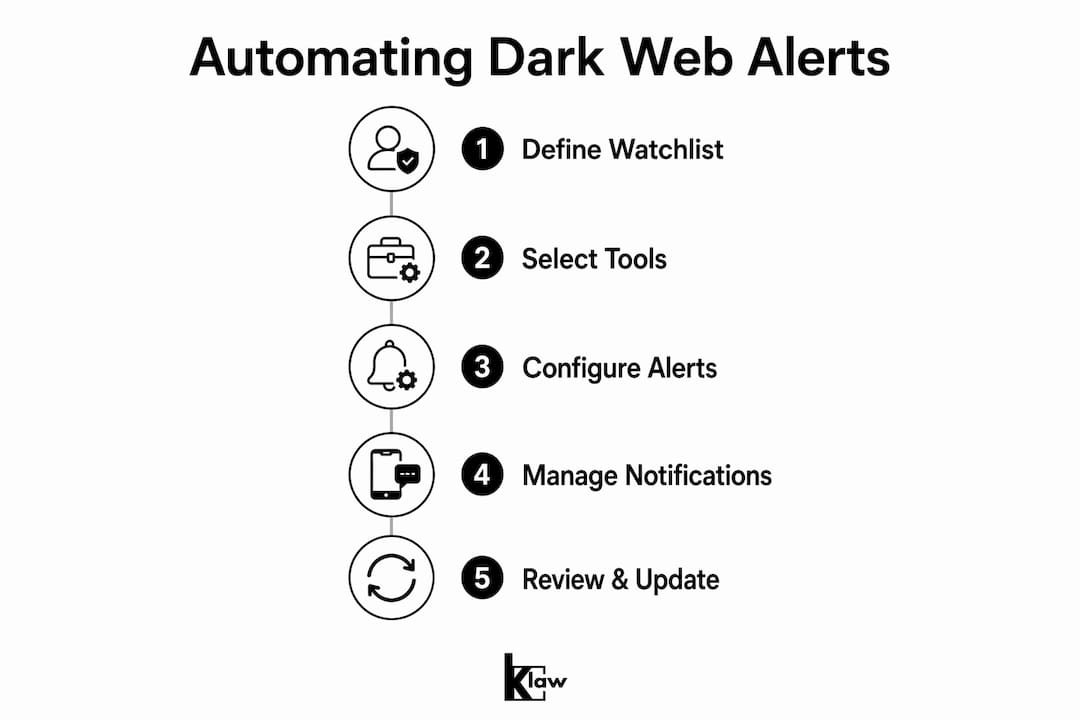
Setting up dark web alert automation correctly from the start saves you from weeks of noise and missed threats later. Follow these steps in order.
-
Define what you are monitoring. List every piece of data that would cause real harm if exposed: email addresses, phone numbers, Social Security numbers, passport numbers, credit card numbers, and usernames tied to financial accounts. The more specific your watchlist, the more precise your alerts will be.
-
Choose and install your platform. For individuals, VoidAccess running in Docker provides a solid self-hosted foundation. For those who prefer a managed service, Klaw scans against over 10,000 breach databases and delivers real-time alerts without requiring any local installation. Install your chosen tool and confirm it connects to its data sources before moving forward.
-
Configure alert parameters and thresholds. Set exact-match rules for your highest-priority identifiers, such as your primary email address or Social Security number. Use fuzzy-matching for secondary identifiers where slight variations in spelling or formatting might appear. Avoid setting thresholds too broadly at the start. A watchlist that is too wide generates alert fatigue before you ever see a real threat.
-
Integrate your delivery channels. Route High-confidence alerts to SMS or a dedicated Slack channel so they reach you immediately. Send Medium-confidence alerts to email for review within a few hours. Log Low-confidence matches for weekly batch review rather than immediate notification. This tiered delivery model mirrors the approach used by ransomware-victim-alerter and prevents your inbox from becoming the bottleneck in your response workflow.
-
Test before going live. Run your configuration against a sample of historical breach data if your platform supports it. Netdata's AI alert system does exactly this, validating new alert settings on past data before they trigger in production. If your tool does not offer this, manually verify that a known test entry in your watchlist fires the correct alert through the correct channel.
-
Connect alerts to your incident response plan. An alert without a defined next step is just noise. Know in advance what you will do when a High-confidence alert fires: which accounts to lock, which passwords to rotate, and who to notify. Klaw's incident response guidance provides a structured starting point for individuals who have not built this workflow yet.
Pro Tip: Set a calendar reminder to review your watchlist every 90 days. New accounts, phone numbers, and email addresses accumulate over time, and an outdated watchlist leaves real exposure gaps.
What are the common challenges when automating dark web monitoring alerts?
Alert fatigue is the most common reason automated monitoring systems fail in practice. When every notification feels equally urgent, none of them get the attention they deserve. Tiered confidence logic solves this directly: high-confidence alerts use exact matches, medium-confidence alerts use fuzzy matching, and low-confidence matches are logged for later review rather than pushed as live notifications. This structure keeps your active alert queue focused on threats that actually require immediate action.
Dark web data sources are also inherently unstable. Onion sites go offline without warning, ransomware groups rebrand or disappear, and forums rotate URLs to avoid takedowns. The technical solution is to combine scheduled API polling with asynchronous Tor crawling and deduplication algorithms. Deduplication is particularly important: without it, the same leaked record can trigger dozens of duplicate alerts across multiple sources, which erodes trust in the system quickly.
Privacy is a real concern when you are running dark web surveillance tools. Self-hosted tools like VoidAccess require you to route traffic through Tor SOCKS5 proxies, which adds a layer of anonymity but also adds configuration complexity. Managed services handle this routing on your behalf, but you are trusting a third party with your watchlist data. Choose a provider with a clear privacy policy and no data-selling practices.
Adjusting alert thresholds is not a one-time task. Review your false-positive rate monthly for the first three months after deployment, then quarterly after that. A threshold that worked well when you first configured it may need recalibration as the data sources your tool monitors evolve.
Alert escalation workflows also matter more than most guides acknowledge. A High-confidence alert that fires at 2 a.m. needs a different routing path than one that fires during business hours. Configure time-based escalation rules so that critical alerts reach you through a channel you actually monitor around the clock, whether that is SMS, a push notification, or a phone call from an automated system.
How to optimize your dark web alert system for long-term protection
Sustained protection requires treating your alert system as a living configuration, not a set-and-forget installation. These five practices keep your monitoring sharp over time.
-
Use AI to refine alert configurations dynamically. AI-powered alert generation trims manual tuning time while improving accuracy, because the model learns from your historical alert data to suggest threshold adjustments you would not catch manually.
-
Implement branching logic for smarter routing. Dynamic branching in alert workflows routes notifications based on severity and type, so a credential leak alert goes to a different channel than a ransomware mention. This keeps each alert in front of the right person or process without requiring manual triage.
-
Update your watchlist based on emerging threats. When a new data broker or dark web marketplace gains prominence, add relevant search terms to your watchlist. Klaw's threat alert settings make this straightforward for non-technical users who need to adjust coverage without editing configuration files.
-
Adopt asynchronous scraping with caching. Asynchronous Tor crawlers paired with local caching reduce the impact of dark web site downtime on your alert coverage. If a source goes offline, cached data keeps your system running until the source recovers, rather than creating a silent gap in monitoring.
-
Connect alerts to agentic AI analyzers. Agentic AI systems can autonomously gather context and perform root-cause investigation when an alert fires, transforming a raw notification into a structured incident report. This moves your response from reactive to genuinely informed within minutes of detection.
Pro Tip: Schedule a quarterly "fire drill" where you simulate a High-confidence alert and walk through your full response workflow. Gaps in your process are far easier to fix before a real incident than during one.
Key takeaways
Automating dark web monitoring alerts requires tiered confidence logic, defined delivery channels, and regular watchlist maintenance to stay effective over time.
| Point | Details |
|---|---|
| Start with a defined watchlist | List every high-value identifier before configuring any monitoring tool. |
| Use confidence tiers for alerts | Separate exact-match, fuzzy-match, and low-confidence alerts into different delivery channels. |
| Combine polling and crawling | Scheduled API polling plus asynchronous Tor crawling prevents silent coverage gaps. |
| Apply AI for ongoing tuning | AI-powered configuration tools reduce manual threshold adjustments and improve accuracy. |
| Connect alerts to response plans | Every High-confidence alert needs a predefined action sequence, not just a notification. |
Why I think most people set up dark web alerts backward
Most guides tell you to pick a tool first and figure out what to monitor second. That is the wrong order, and it is why so many people end up with alert systems they ignore within a month. The watchlist defines everything: the tool, the thresholds, the delivery channels, and the response workflow. If you do not know exactly what data you are protecting, no amount of AI tuning will make your alerts useful.
The AI impact on cybersecurity is real, and agentic analyzers that turn raw alerts into structured incident reports are genuinely changing what individuals can accomplish without a security team. But the technology only works if the inputs are clean. A vague watchlist fed into a sophisticated AI analyzer still produces vague output.
The other thing I have seen consistently: people underestimate how much dark web monitoring overlaps with freelancer credential exposure. If you use the same email address across client platforms, gig marketplaces, and personal accounts, a single breach can cascade across your entire digital identity. Monitoring that one email address with a properly configured alert system is one of the highest-return security investments you can make.
The future of this space is not more alerts. It is fewer, better alerts that arrive with enough context to act on immediately. That is the direction every serious platform is moving, and it is the standard you should hold your own system to.
— Lucky
Start monitoring your dark web exposure with Klaw
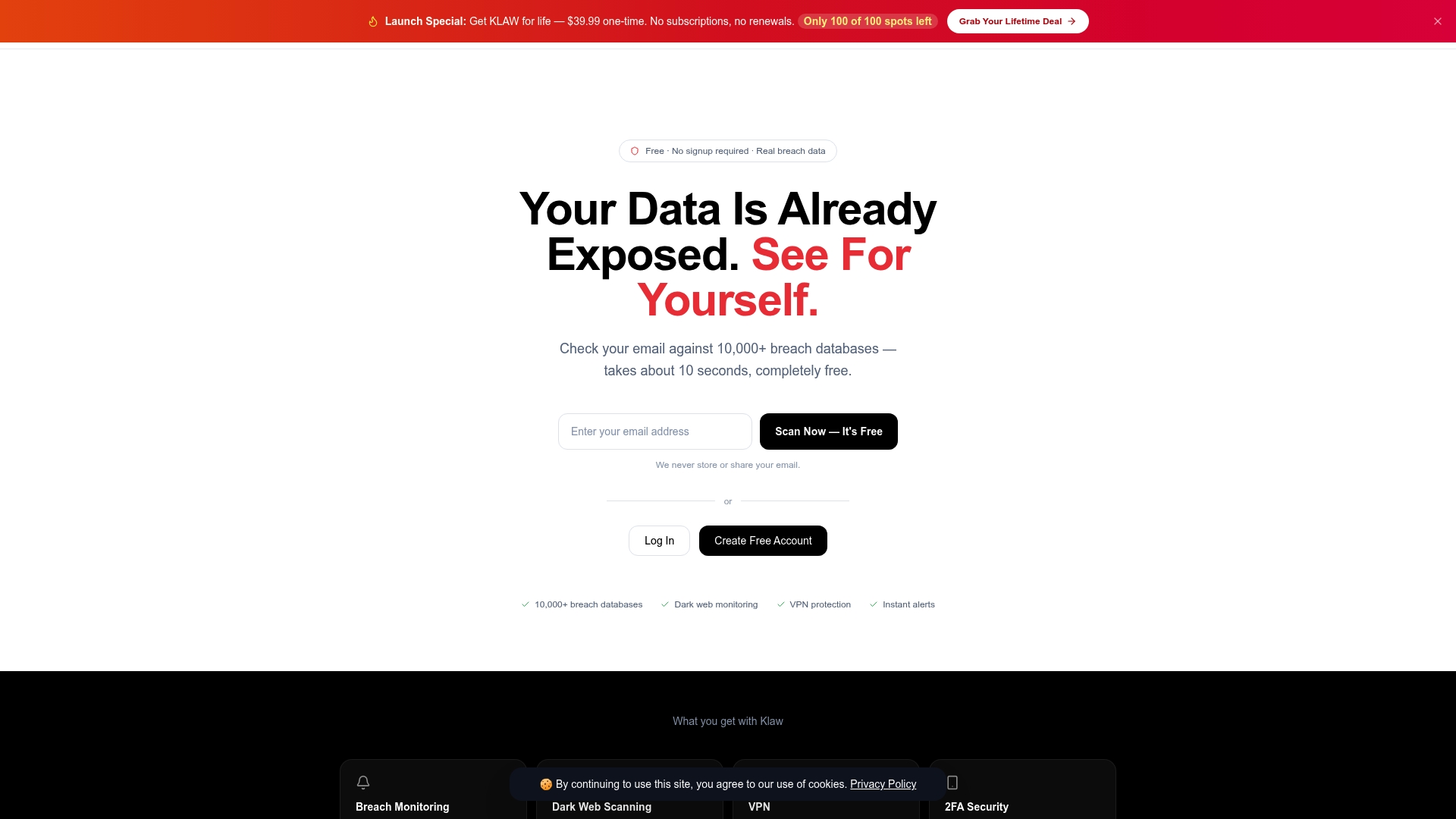
Klaw scans your email addresses against over 10,000 breach databases and delivers real-time dark web alerts the moment your data appears in a new breach or dark web listing. There are no hidden fees, no subscription traps, and no technical setup required on your end. Klaw handles the monitoring infrastructure while you focus on acting on the alerts that matter. If you want to see your current exposure before committing to anything, Klaw's free scan results give you an immediate picture of where your data stands today. Automated protection starts with knowing what is already out there.
FAQ
What does it mean to automate dark web monitoring alerts?
Automating dark web monitoring alerts means configuring a system to continuously scan dark web sources and send you notifications without manual intervention when your personal data appears. Tools like VoidAccess and DarkIQ handle the scanning and alert delivery automatically once configured.
How do I reduce false positives in dark web alerts?
Use tiered confidence logic: route only exact-match alerts as immediate notifications and log fuzzy-match results for periodic review. Ransomware-victim-alerter uses this three-tier model to keep actionable alerts separate from low-confidence noise.
Are open-source dark web monitoring tools safe to use?
Open-source tools like VoidAccess are safe when configured correctly, but they require Tor proxy setup and Docker management that adds technical overhead. Managed services like Klaw remove that complexity while maintaining privacy through their own secure infrastructure.
How often should I update my dark web watchlist?
Review and update your watchlist every 90 days at minimum, adding new email addresses, phone numbers, or account identifiers as your digital footprint changes. Emerging threat sources and new dark web marketplaces also warrant watchlist additions when they gain prominence.
What should I do immediately after receiving a dark web alert?
Rotate the password for any account associated with the exposed credential, enable two-factor authentication if it is not already active, and check for unauthorized account activity. Klaw's guidance on securing accounts after a leak walks through each step in detail.