
TL;DR:
- Breach monitoring is an automated service that scans dark web sources for your leaked data and alerts you immediately. It helps shorten the attack window by providing early detection of exposed credentials, allowing rapid response before attackers can misuse stolen information. To maximize protection, users should register all identifiers, build response workflows, and act promptly on alerts to prevent significant damage.
Breach monitoring is an automated security service that continuously scans dark web forums, hacker marketplaces, and breach databases for your exposed personal or business data, then alerts you the moment your information appears. Most people discover a breach months after the fact, when attackers have already used stolen credentials to open fraudulent accounts, drain funds, or sell access to other criminals. This article explains how breach monitoring works, what it covers, and exactly how individuals and small business owners can use it to close that gap before real damage is done.
What is breach monitoring and how does it protect your data?
Breach monitoring, also called dark web monitoring or credential monitoring in the security industry, is a detection service that acts as your early-warning system against data exposure. These services scan email addresses, passwords, Social Security numbers, financial information, phone numbers, and banking details across thousands of sources, operating 24/7 to deliver real-time notification. The moment your data matches a known leak, you get an alert.

The types of data monitored go well beyond what most people expect. A quality service tracks not just your primary email address but also usernames, passport numbers, and even partial credit card data tied to your identity. Klaw, for example, scans against over 10,000 breach databases to give individuals and small business owners a clear picture of their exposure. That breadth matters because attackers aggregate data from multiple breaches to build detailed profiles of their targets.
Understanding what breach monitoring covers is the first step toward using it effectively. It does not prevent a breach from happening at a third-party company. What it does is shrink the time between when your data is stolen and when you know about it, which is the window attackers rely on most.
How does breach monitoring work to detect exposed information?
The detection process runs through several distinct layers, each targeting a different part of the internet where stolen data surfaces.
- Dark web forum scanning. Automated crawlers index private forums where hackers trade and sell stolen credentials. These are not publicly accessible sites. Quality services maintain access to underground communities that require vetting to join.
- Paste site monitoring. Sites like Pastebin are frequently used to dump stolen data publicly. Breach monitoring tools index these dumps in near real time and match content against your registered identifiers.
- Stealer log analysis. Malware called info-stealers harvests credentials directly from infected devices and uploads them to private Telegram channels or hacker forums. Effective services monitor stealer logs, ransomware leak sites, and Telegram channels for fresher data than public breach databases ever contain.
- Ransomware leak site indexing. When ransomware groups publish stolen files to pressure victims into paying, that data becomes searchable. Breach monitoring services index these publications and flag any matches to your data.
- Automated identifier matching. Every source is cross-referenced against the email addresses, usernames, and other identifiers you register with the service. When a match occurs, an alert fires automatically.
The speed difference between services matters enormously here. Batch-processing services check sources once every 24 hours or longer. Real-time services trigger alerts within minutes of a match. For credential theft, that time difference can determine whether an attacker gets in before you change your password.
Pro Tip: Register every email address you use, not just your primary one. Old accounts tied to forgotten addresses are a common entry point because people rarely monitor them.
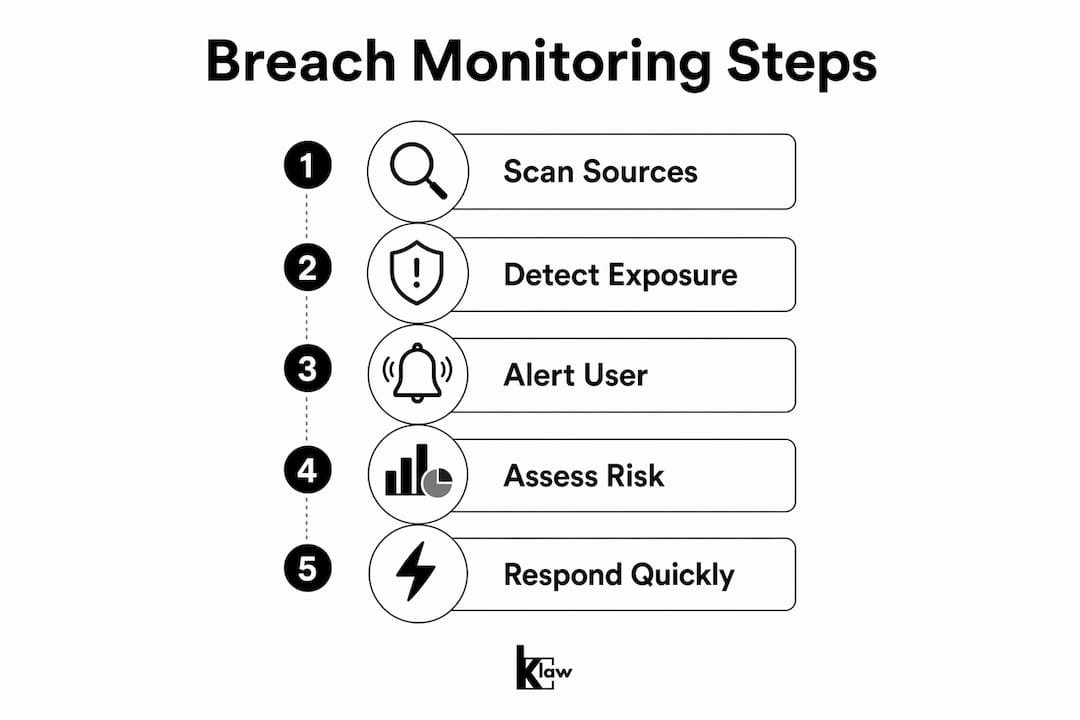
You can also automate dark web monitoring alerts to connect directly with your account management workflows, triggering password resets or session invalidations the moment a match is detected. That automation is what separates a passive alert system from an active defense.
What are the key benefits of breach monitoring services?
The core benefit is time. Breach monitoring closes the attack window by enabling victims to invalidate compromised credentials within hours of detection. That speed directly limits the damage an attacker can do with stolen data.
Here is what that translates to in practice for individuals and small business owners:
- Faster credential invalidation. When you know a password is compromised, you can change it before an attacker uses it. Without monitoring, you may not know for weeks or months.
- Visibility into third-party breaches. You cannot control whether a vendor, app, or service you use gets breached. Breach monitoring gives you visibility into those exposures even when the breached company does not notify you promptly.
- Automated response workflows. Automating breach detection to account management can reduce response time by hours. For small businesses, that means a compromised employee credential triggers an automatic password reset rather than waiting for someone to notice unusual activity.
- Regulatory compliance support. Many data protection regulations require organizations to demonstrate they monitor for and respond to breaches. Breach monitoring services provide documented alerts and response timelines that support compliance reporting.
- Cost-effective protection. The average cost of a data breach runs into the tens of thousands of dollars for small businesses when you factor in recovery, legal exposure, and lost customers. A monitoring service costs a fraction of that.
One statistic worth understanding in full: 97% of security leaders worry about insider risks, which makes external detection tools like breach monitoring a necessary complement to internal controls. Internal systems can only see what happens inside your network. Breach monitoring sees what happens after data leaves it.
For freelancers and independent workers, dark web monitoring provides the same protection that enterprise security teams build into their workflows, without requiring a dedicated IT department to manage it.
How does breach monitoring compare to identity theft protection?
These two services are frequently confused, and the distinction matters when you are deciding where to spend your security budget.
| Feature | Breach monitoring | Identity theft protection |
|---|---|---|
| Core function | Detects exposed credentials and PII in breach data | Monitors credit, identity documents, and financial accounts |
| Alert type | Notifies you when your data appears in a breach | Notifies you of suspicious financial activity or credit inquiries |
| Response tools | Password reset guidance, credential alerts | Credit freezes, identity restoration services, legal assistance |
| Coverage scope | Dark web, hacker forums, breach databases | Credit bureaus, financial institutions, government records |
| Best for | Early detection of credential exposure | Responding to identity theft after it occurs |
Breach monitoring is specifically a data breach alert tool. It tells you your data is out there. Identity theft protection is a broader service that helps you respond after your identity has been misused. The two are complementary, not interchangeable.
A common misconception is that breach monitoring prevents identity theft. It does not. What it does is give you the earliest possible warning so you can act before theft occurs. Pairing breach monitoring with strong passwords, two-factor authentication, and endpoint security creates a layered defense that is significantly harder to penetrate than any single tool alone.
Practical steps for implementing breach monitoring effectively
Choosing and using a breach monitoring service well requires more than signing up and waiting for alerts. These steps make the difference between a service that protects you and one that generates noise you ignore.
Choose a service with broad source coverage. Not all breach monitoring services access the same data. High-quality services access private underground forums and real-time stolen credential sources beyond public breach databases. Ask specifically whether a service monitors stealer logs and Telegram channels, not just known public breaches.
Register all your identifiers. Set up alerts for every email address, username, phone number, and domain name associated with your personal or business identity. Small business owners should also register their company domain and key employee email addresses.
Build a response workflow before you need it. Decide in advance what you will do when an alert fires. For individuals, that means knowing which accounts share a compromised password. For businesses, it means having a documented process for credential resets and notifying affected users.
Act within hours, not days. Organizations that reset compromised credentials within hours mitigate attacks successfully. Waiting 48 hours to respond to a breach alert is long enough for an attacker to pivot from one account to several others.
Pro Tip: When you receive a breach alert, check whether the compromised password was reused on other accounts before changing just the one flagged. Password reuse is the primary way a single breach becomes a multi-account takeover.
For small businesses managing multiple employees, integrating breach alerts with your identity and access management system is worth the setup time. That integration means a detected credential triggers an automatic response rather than depending on someone reading an email at the right moment. You can review server management practices that pair well with automated breach response workflows to build a more complete security posture.
Avoid alert fatigue. Configure your service to prioritize high-risk alerts, such as active credential matches, over lower-priority notifications. A service that floods you with alerts trains you to ignore them.
Key takeaways
Breach monitoring delivers its full value only when detection is paired with a fast, pre-planned response that invalidates compromised credentials before attackers can use them.
| Point | Details |
|---|---|
| Definition is specific | Breach monitoring detects exposed data in breach sources. It does not prevent breaches or restore identity. |
| Speed determines outcome | Resetting compromised credentials within hours stops most attacks before they escalate. |
| Source quality matters | Services that access stealer logs and private forums detect fresher breaches than those using only public databases. |
| Response must be planned | An alert without a response workflow delivers little security value. Build the process before you need it. |
| Combine tools for full coverage | Pair breach monitoring with two-factor authentication and identity theft protection for layered defense. |
Why breach monitoring deserves more credit than it gets
Most security conversations for individuals and small businesses focus on prevention: strong passwords, software updates, firewalls. Those matter. But they assume you control every system that holds your data, and you do not. Every app you sign up for, every vendor your business uses, every platform that stores your email address is a potential breach point outside your control.
What I have seen consistently is that people underestimate how long stolen credentials sit unused before an attacker deploys them. Dark web monitoring enables proactive defense by detecting credential exposure before attackers weaponize them, shifting security from reaction to prevention. That shift is the entire value proposition, and it is one that most individuals and small businesses have not built into their security practice yet.
The other thing worth saying plainly: monitoring must be ongoing because cybercriminals repackage old data. A breach from three years ago can resurface in a new dump with updated context that makes it more dangerous, not less. One-time scans give you a snapshot. Continuous monitoring gives you a defense.
The businesses and individuals I see handling this well are not necessarily the ones with the biggest security budgets. They are the ones who treat breach monitoring as a standard operational process, the same way they treat backing up data or renewing software licenses. It is not glamorous. It works.
— Lucky
See your exposure before attackers do
If you are not sure whether your email address or business credentials are already circulating on the dark web, the answer is worth knowing now rather than after the damage is done.
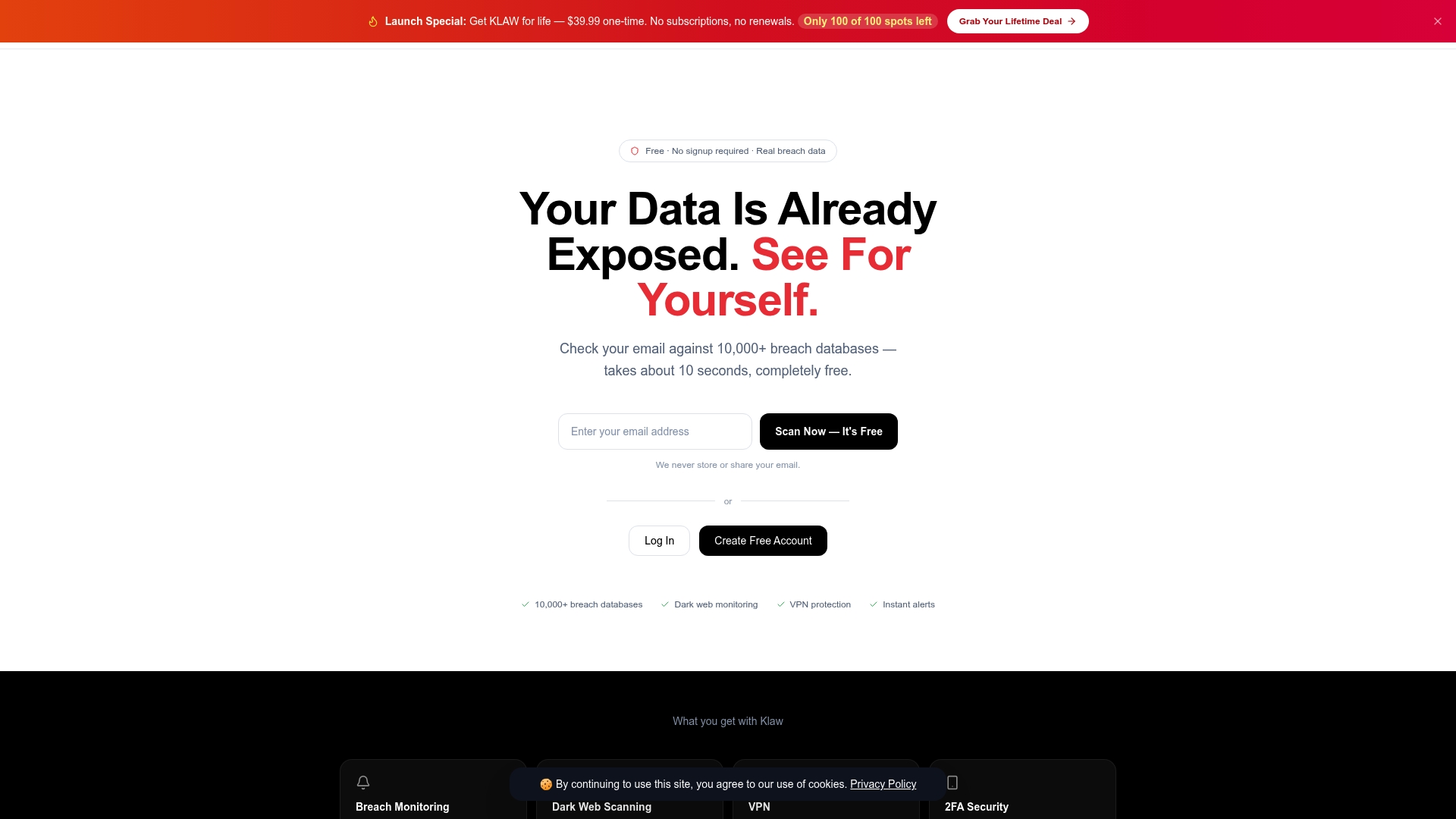
Klaw's Dark Web Alerts service scans your email addresses against over 10,000 breach databases and delivers real-time alerts the moment your data appears in a new breach. There are no hidden fees and no subscription traps. You can also run a free breach scan to see your current exposure before committing to ongoing monitoring. For individuals worried about identity theft and small business owners protecting employee credentials, Klaw gives you the detection layer that makes every other security measure more effective.
FAQ
What is breach monitoring in simple terms?
Breach monitoring is an automated service that scans dark web forums, hacker sites, and breach databases for your personal or business data, then alerts you when it finds a match. Think of it as a smoke detector for your digital identity.
How does breach monitoring differ from a one-time breach check?
A one-time check shows your exposure at a single point in time. Breach monitoring runs continuously, which matters because cybercriminals repackage and republish stolen data long after the original breach occurred.
What data does breach monitoring typically cover?
Most services monitor email addresses, passwords, Social Security numbers, phone numbers, financial account details, and usernames. Higher-quality services also track stealer log data and ransomware leak publications.
Is breach monitoring worth it for small businesses?
Yes. A single compromised employee credential can give an attacker access to internal systems, client data, and financial accounts. Breach monitoring detects that exposure early enough to reset credentials before an attacker acts on them.
What should I do when I receive a breach alert?
Change the compromised password immediately, check whether that password was reused on other accounts, and enable two-factor authentication on the affected account if it is not already active. Acting within hours significantly reduces your risk.