
TL;DR:
- Your home address is frequently leaked online through various non-attack methods, such as data brokers and web scraping.
- Mitigating exposure requires ongoing source control, regular monitoring, and proactive opt-out efforts across multiple platforms.
Your home address feels permanent, physical, and private. Yet it's one of the most widely leaked pieces of personal data online, and most of the time, you never see it happen. Understanding why address info gets compromised, which security professionals call a personal data breach or PII exposure, matters because the methods are far more varied than most people expect. It's not just hackers breaking into databases. Scrapers, data brokers, vendors, and stolen credentials all play a role. Knowing the full picture is the first step toward doing something about it.
Table of Contents
- Key takeaways
- Why address info gets compromised through technical attacks
- Third-party and vendor pathways for address exposure
- Non-breach routes: scraping and data brokerage
- What compromised address data actually does to you
- Protecting your address information going forward
- My take on why most fixes fall short
- How Klaw helps you stay ahead of address exposure
- FAQ
Key takeaways
| Point | Details |
|---|---|
| Hacking is not the only risk | Addresses leak through scraping, third-party vendors, and data brokers, often without any direct attack. |
| Third-party breaches are surging | 48% of breach incidents in 2025 involved a third party, meaning your vendor's weakness is your problem too. |
| Data brokers recirculate your address endlessly | Opting out of one broker doesn't stop others from reselling your data repeatedly. |
| Address data amplifies identity theft | Historical and current address records let attackers link identities and bypass verification checks. |
| Monitoring and source control both matter | Effective protection combines reducing public exposure at the source with real-time breach monitoring. |
Why address info gets compromised through technical attacks
Most people picture a lone hacker cracking a password when they think about a data breach. The reality of how address information is leaked is considerably more layered. Attackers rarely target your address specifically. Instead, they gain access to a system and harvest whatever identity fields are stored there, including names, phone numbers, and physical addresses.
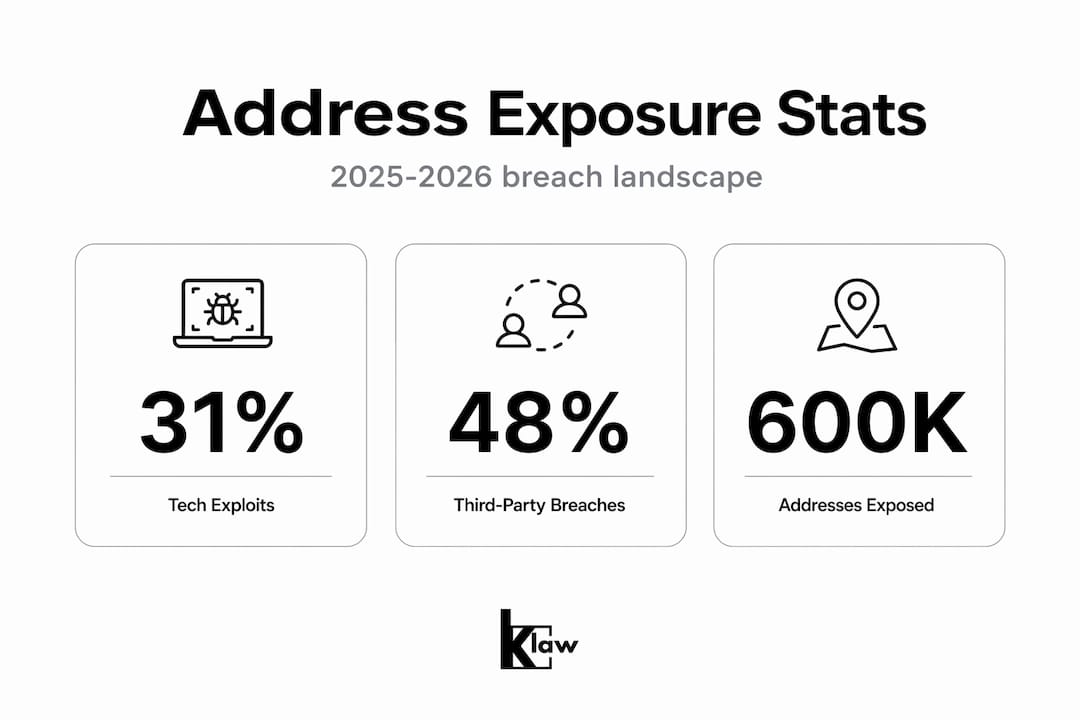
The leading method today is vulnerability exploitation. Exploitation now accounts for 31% of initial attack vectors in breaches, up from 20% just two years ago, according to Verizon's 2026 Data Breach Investigations Report. That means unpatched software, misconfigured servers, and outdated systems are now the most common entry points. Once inside, attackers use their existing access to pull identity records in bulk.
Credential theft and phishing remain significant contributors as well. A sophisticated example: AiTM phishing campaigns intercept authentication tokens rather than passwords, letting attackers impersonate users after login and extract whatever data those accounts can access. Address records stored in a customer profile or shipping history become collateral damage.
Credential abuse also enabled a high-profile government breach where stolen credentials exposed 600,000 addresses belonging to sensitive individuals in Lithuania's Migration Department. That breach directly enabled physical surveillance and targeted phishing campaigns tied to those addresses. The message is clear: attackers use the shortest path to the data, whether that's a software flaw, a stolen password, or a phishing link.
- Vulnerability exploitation: Unpatched systems provide direct database access to attackers.
- Credential theft: Stolen usernames and passwords unlock accounts that contain stored address fields.
- Phishing and AiTM attacks: Session token hijacking gives attackers full account access without needing your password.
- Social engineering: The 2026 ADT breach showed how social engineering tactics can bypass technical defenses to expose home security account data including physical addresses.
Pro Tip: Check whether the services that store your address, such as e-commerce accounts or utility portals, have two-factor authentication enabled. Stolen credentials become far less useful when a second factor is required.
Third-party and vendor pathways for address exposure
Here's the scenario that catches most people off guard. Your primary service provider has strong security. Your password is unique and long. You've done everything right. And yet your address ends up in a breach anyway, because a vendor that company used was not as careful.

Third-party involvement in breaches reached 48% of all incidents in 2025, nearly doubling from 30% the year before. That's the reality of modern data ecosystems: your information passes through identity verification providers, payment processors, shipping partners, analytics tools, and cloud storage services. Each handoff is a potential exposure point.
Data brokers and identity verification providers are particularly dangerous aggregators. A single breach at one of these companies can expose tens of millions of records at once. The Infutor breach illustrates exactly how severe this gets. Nearly 677 million Americans' identity records were exposed on a misconfigured server, including current and historical addresses, Social Security numbers, and birthdates. All of this was posted on criminal forums. You didn't need to be Infutor's customer to be in that dataset. You just had to exist in their compiled data.
Understanding breach database risks helps illustrate how data from third-party breaches accumulates and circulates across the internet long after the initial event. The practical takeaway: assume your address has passed through multiple third parties you've never directly interacted with. That assumption should shape how you monitor your exposure.
Non-breach routes: scraping and data brokerage
Not every address compromise traces back to a cyberattack. A large share of address info privacy risks come from completely legal, automated activity happening in plain sight.
Web scrapers crawl websites constantly, extracting any address text they find. If your home address appears in a business registration, a personal website, a forum post, or a public records filing, scrapers will find it and harvest it. Scraped addresses feed directly into marketing lists and are sold to data brokers who compile and resell them. Each sale creates another copy of your address in another database.
Here's a comparison that shows the difference between breach-based and non-breach address exposure:
| Exposure type | How it happens | Your control |
|---|---|---|
| Database breach | Attacker exploits vulnerability or credential | Low. Depends on provider's security. |
| Third-party vendor breach | Vendor's system is compromised | Very low. You may not even know. |
| Web scraping | Public address text harvested automatically | Medium. Remove visible address text from sites you control. |
| Data broker resale | Scraped or purchased data resold repeatedly | Partial. Opt-outs help but removal is incomplete due to constant resale. |
The broker pipeline is persistent by design. Opting out of one broker does not prevent the dozens of others who already bought your data from selling it again. Automated broker opt-outs can help reduce the volume of active listings, but they require ongoing effort to maintain any effect.
Pro Tip: If your address appears on a personal or business website, consider replacing visible text with an image or a contact form. Scrapers read text. They can't easily extract an address embedded in an image file.
What compromised address data actually does to you
Knowing your address is exposed is one thing. Understanding what an attacker can actually do with it is another, and the answer is more serious than most people expect.
Address data on its own is useful. Combined with your name, phone number, and email, it becomes a foundation for multiple types of fraud. Historical address records amplify identity fraud by allowing attackers to trace your identity across time, link old accounts to new ones, and defeat knowledge-based authentication questions that ask about previous residences.
The real-world consequences of compromised address data include:
- Targeted phishing: Attackers reference your address in emails or texts to appear legitimate, dramatically increasing the chance you'll trust the message.
- Mail fraud: Physical mail scams, fake checks, and fraudulent offers get sent to your home address with personal details that make them convincing.
- Account takeover: Address information is used to pass identity verification checks that companies use to reset credentials.
- Physical surveillance and swatting: Exposed addresses have been used to locate individuals, conduct surveillance, or direct dangerous false emergency calls to someone's home.
"Address exposure is not just a digital problem. Once someone knows where you live, the risks extend into the physical world in ways that no firewall can fix."
The Lithuania government breach makes this concrete. Those 600,000 exposed home addresses belonged to individuals in sensitive government roles. The attack didn't just create a fraud risk. It created a physical safety threat. While most individuals aren't in that situation, the principle holds: address exposure compounds every other piece of leaked information attached to your identity.
Protecting your address information going forward
Prevention here is not about achieving perfect invisibility. It's about reducing your attack surface and detecting problems early. Here's how to approach it:
-
Audit your public footprint. Search your full name and address together. Check Google, data broker sites, and public records aggregators. Document what you find. You can also remove yourself from the internet by following guides that cover the major platforms and data sources.
-
Submit opt-out requests to data brokers. Start with the largest ones: Whitepages, Spokeo, BeenVerified, Intelius, and MyLife. Klaw's automated removal tool handles this at scale and repeats the process since broker listings often return after initial removal.
-
Minimize how you share your address online. Use a P.O. box or virtual mailbox for non-essential registrations. Never put your home address in public social media profiles or forum bios.
-
Secure every account that stores your address. Enable multi-factor authentication on e-commerce accounts, banking portals, and subscription services. If an attacker can't use stolen credentials, your stored address stays inaccessible. Knowing how to secure accounts after a credential leak is a core skill worth building.
-
Monitor for breach exposure. Set up dark web monitoring and identity alerts so you learn about exposure quickly rather than months later. Speed matters because the window between a breach and active fraud is narrowing.
Pro Tip: When signing up for any service that doesn't need to mail you something physical, enter a fake or incomplete address. Many services collect addresses simply because the form field exists, not because they actually need it.
My take on why most fixes fall short
I've spent years looking at how personal data moves online, and the thing that strikes me most is how many people treat privacy as a one-time task. They delete their Facebook, submit a few opt-out requests, and consider the problem solved. That approach misunderstands how data flows work.
Address data, once exposed, doesn't sit still. It recirculates through broker networks, gets packaged into breach datasets sold on criminal forums, and shows up in places you'd never think to check. The non-technical routes like scraping and brokerage account for a massive share of ongoing exposure, yet most advice focuses entirely on breach prevention.
What actually works is a combination of source control, which means reducing how many places your address appears to begin with, and persistent monitoring, which means detecting exposure quickly when it does happen. The people I've seen handle this well don't just opt out once. They treat it as an ongoing process. You check your exposure regularly, remove new listings as they appear, and stay alert to signs that your identity is being used without your knowledge. That's not paranoia. It's how the data environment actually works.
— Lucky
How Klaw helps you stay ahead of address exposure
If this article made one thing clear, it's that protecting your address requires visibility into where your data appears and how fast you know when something changes. Klaw was built exactly for that.
Start with a free scan of your email against over 10,000 breach databases to see what's already out there. The Security Trend Dashboard gives you an ongoing view of your data exposure across breach sources, including address data that has surfaced in known leaks. When your information appears somewhere new, Dark Web Alerts notify you in real time so you can act before damage compounds. You can customize exactly what triggers an alert through Threat Alert Settings. Klaw also runs automated data broker removals so your address disappears from resale lists continuously, not just once. No hidden fees. No subscription traps.
FAQ
What is the most common reason address info gets compromised?
Vulnerability exploitation is now the leading cause, accounting for 31% of initial attack vectors in breaches according to Verizon's 2026 report. However, third-party vendor breaches and web scraping account for a significant additional share of address exposure.
Can my address be compromised even if I've never been hacked directly?
Yes. Third-party breaches drove 48% of incidents in 2025, meaning a vendor or data broker that holds your information can expose it without any attack on you personally.
What can someone do with just my home address?
An attacker with your address can conduct targeted phishing, commit mail fraud, use it to pass identity verification checks, or in extreme cases, enable physical surveillance. Combined with other leaked data, addresses help attackers bypass knowledge-based verification by using historical residence information.
How do I know if my address has been exposed in a breach?
Signs include unexpected mail addressed to you with personal details, receiving phishing messages that reference your home address, or unfamiliar account activity. Running a dark web scan with a tool like Klaw gives you a more definitive answer faster.
Do data broker opt-outs actually remove my address permanently?
No. Opt-outs provide partial, temporary relief because brokers continually re-scrape and repurchase data. Effective removal requires repeated requests over time or an automated service that handles re-submissions on an ongoing basis.