
TL;DR:
- Phishing is a cyberattack that tricks individuals into revealing personal information for financial theft or identity fraud. It involves impersonating trusted organizations and exploiting human psychology, not software vulnerabilities, to deceive victims into clicking malicious links or attachments.
Phishing is a cyberattack that tricks you into handing over personal information so criminals can steal your money or identity. Attackers impersonate trusted organizations, like your bank, the IRS, or a well-known retailer, to steal banking logins, credit card numbers, and passwords. Once they have that data, the theft happens fast. Understanding the full chain from deceptive message to financial loss is the first step toward protecting yourself.
How phishing leads to theft, step by step

Phishing works because it targets human psychology, not software vulnerabilities. Attackers exploit trust and urgency to push victims into acting before they think. A message arrives that looks exactly like a PayPal security alert or a Microsoft account warning. The pressure to act immediately overrides your instinct to pause and verify.
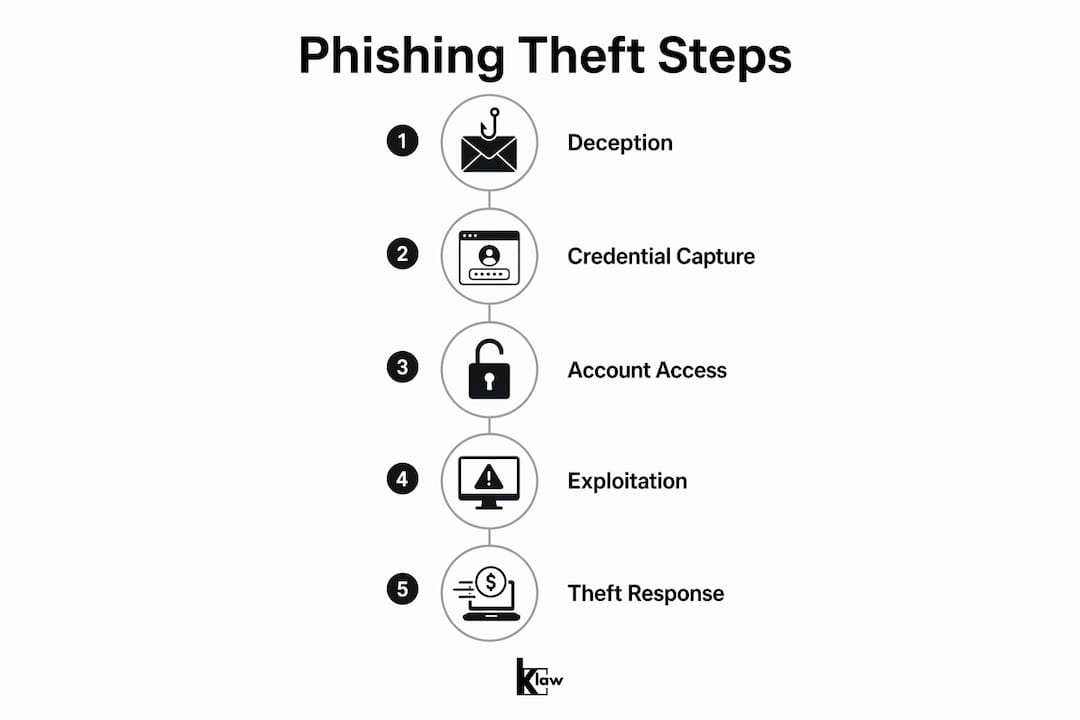
The attack follows a predictable sequence:
- The lure. The attacker sends an email, text, or social media message impersonating a trusted brand or person. The message looks legitimate, with real logos and matching language.
- The hook. The message contains a malicious link or attachment. Clicking the link takes you to a fake website designed to capture your credentials. Opening the attachment installs malware on your device.
- The capture. You type your username and password into the fake site. The attacker records them in real time. Malware variants can also log keystrokes or take screenshots without any action from you.
- The theft. With your credentials, the attacker logs into your real bank account, email, or credit card portal. They transfer funds, make purchases, or sell your data on the dark web.
- The cover. Stolen money moves quickly through mule networks across multiple banks, making recovery difficult once funds leave the first account.
Pro Tip: Before clicking any link in an email, hover over it to preview the actual URL. If the domain does not match the sender's official website exactly, do not click.
Ways phishing causes theft beyond stolen passwords
Most people think phishing ends at a stolen password. The reality is far more layered. Identity theft after phishing is rarely a single event. Attackers use stolen data as a starting point to escalate into full account takeovers and ongoing fraud.
Here are the less obvious mechanisms that turn a phished password into prolonged theft:
- AiTM (Adversary-in-the-Middle) attacks. These attacks sit between you and a legitimate website, relaying your login in real time. AiTM phishing intercepts MFA session cookies after you complete multi-factor authentication. The attacker captures the authenticated session token, which grants them persistent access without needing your password again.
- Phone porting scams. An attacker uses your stolen personal details to convince your mobile carrier to transfer your phone number to a SIM they control. Once they own your number, every SMS-based two-factor authentication code goes to them. They then reset passwords on your bank, email, and other accounts.
- Credential stuffing. Phished passwords from one site get tested against dozens of other services automatically. If you reuse passwords, one phishing attack can unlock multiple accounts. Learn more about how credential stuffing works and why it amplifies phishing damage.
- Multi-step fraud chains. Attackers combine your stolen email access, banking credentials, and personal details to apply for loans, open new credit lines, or file fraudulent tax returns in your name.
"Phishing-enabled identity theft is not a single event. Scammers often escalate to account takeovers using stolen info to intercept 2FA and change credentials, locking victims out of their own accounts entirely."
The most dangerous aspect of these escalations is the time gap. You may not realize your phone number was ported or your session was hijacked until significant damage is already done.
Real-world phishing fraud examples and their financial impact
Concrete cases show just how costly phishing attack consequences can be. These are not abstract risks.
| Case | Method | Financial Impact |
|---|---|---|
| Warren County, NY | Multi-bank mule network following phishing | $3.3 million stolen |
| FBI IC3 2025 Report | Phishing and spoofing complaints | $215 million in direct losses |
| Government impersonation scams | Phishing exploiting authority and urgency | $797.9 million in losses |
The Warren County case is particularly instructive. Investigators found that stolen funds moved through layered mule networks across multiple banks, making recovery extremely difficult. Early detection and rapid reporting were the only factors that gave investigators any chance of recovery.
The FBI's Internet Crime Complaint Center recorded 191,561 phishing complaints in 2025. That volume means phishing is not a rare event targeting only careless people. It is a mass-scale operation targeting everyone.
Government impersonation scams illustrate how phishing schemes exploit authority. These scams nearly doubled in 2025, generating $797.9 million in losses. Attackers send messages posing as the IRS, Social Security Administration, or FBI, creating fear that drives victims to hand over sensitive information without question.
How to prevent phishing theft and respond if targeted
Preventing phishing theft starts with recognizing the warning signs before you act. Most phishing messages share common traits you can learn to spot.
Recognizing phishing messages:
- The sender's email address does not match the official domain. "[email protected]" is not PayPal.
- The message creates extreme urgency: "Your account will be closed in 24 hours."
- Links in the message lead to domains that look similar to real ones but are slightly off.
- Attachments arrive unexpectedly, especially from senders you do not regularly receive files from.
- The message asks you to confirm personal details, passwords, or payment information.
Immediate steps if you suspect you clicked a phishing link:
- Change your password on the affected account immediately, and on any account where you used the same password.
- Contact your bank or card issuer to report the incident and freeze transactions if needed. Prompt reporting to your bank is the single most effective action to limit financial loss.
- Check your credit report for unauthorized accounts or inquiries. In the United States, you can request free reports from Equifax, Experian, and TransUnion.
- Report the incident to the FBI's IC3 at ic3.gov and to the FTC at reportfraud.ftc.gov.
- Review your email account for forwarding rules the attacker may have set up to intercept future messages.
Long-term protections:
- Use a hardware security key or an authenticator app instead of SMS-based two-factor authentication. SMS codes are vulnerable to phone porting attacks.
- Monitor your accounts for unusual activity. Knowing the warning signs of an email breach gives you a head start before damage escalates.
- Set up dark web monitoring to receive alerts if your credentials appear in a breach database.
Pro Tip: If you receive an urgent message from your bank or a government agency, hang up or close the email and call the official number listed on their website directly. Never use contact information provided in the suspicious message itself.
Key takeaways
Phishing leads to theft through a chain of deception, credential capture, and account exploitation that can escalate far beyond a single stolen password.
| Point | Details |
|---|---|
| Phishing targets psychology | Attackers use urgency and impersonation to bypass your judgment before you can verify a message. |
| MFA alone is not enough | AiTM attacks capture session cookies after MFA succeeds, giving attackers persistent access. |
| Theft escalates quickly | Stolen credentials enable phone porting, account takeovers, and multi-step fraud chains. |
| Speed of response matters | Reporting to your bank and changing passwords immediately limits how far stolen funds can travel. |
| Monitoring reduces long-term damage | Dark web alerts and breach monitoring catch compromised credentials before attackers fully exploit them. |
Why I think most people underestimate phishing's real danger
Most people picture phishing as an obvious scam email full of typos. That mental model is dangerously outdated. Modern phishing messages are polished, personalized, and timed to catch you when you are distracted. I have reviewed cases where the fake login page was pixel-perfect, indistinguishable from the real site without inspecting the URL.
The part that surprises people most is the MFA bypass. Many assume that turning on two-factor authentication makes them safe. AiTM phishing proves otherwise. Attackers do not need to break your MFA. They just wait for you to complete it, then steal the session token that proves you already passed. The lock is still there. They just walked through the door after you opened it.
The other underestimated factor is response speed. Stolen funds move through mule networks within hours. Every minute between the theft and your bank call is a minute that money spends moving further away. Rapid containment is not optional. It is the difference between partial recovery and total loss.
Phishing will keep evolving. Attackers now use AI to generate convincing messages at scale, targeting specific individuals with details scraped from social media. The defense is not a single tool. It is a habit of skepticism, fast response, and continuous monitoring.
— Lucky
Klaw's tools for detecting phishing exposure early
Knowing your credentials are compromised before an attacker uses them is the most valuable position you can be in. Klaw scans your email against over 10,000 breach databases for free, giving you visibility into whether your data is already circulating on the dark web.
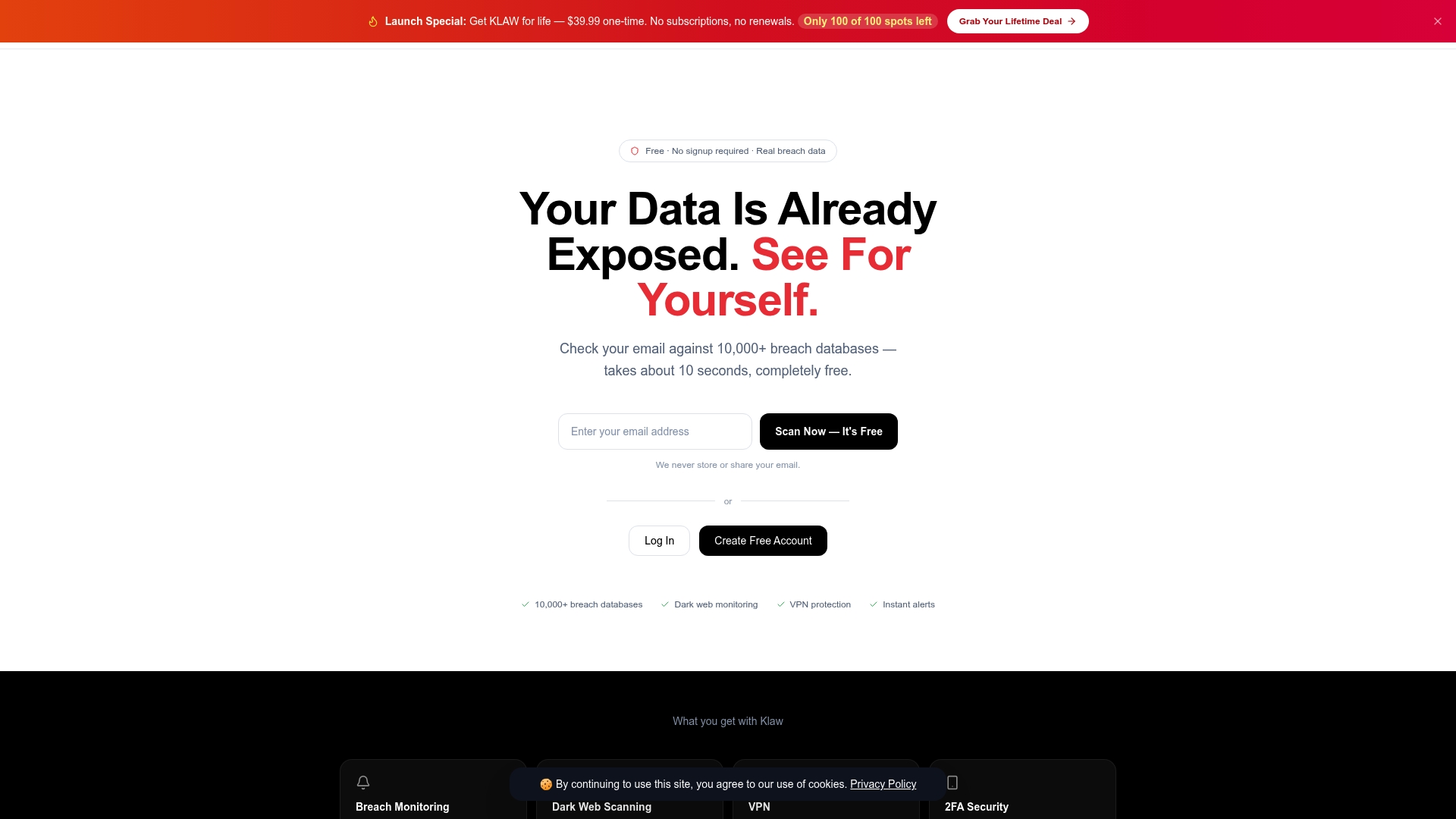
Klaw's Dark Web Alerts notify you the moment your credentials appear in a new breach, so you can act before an attacker does. The Security Trend Dashboard tracks active phishing threats targeting your type of accounts. If your data has already been exposed, Klaw's identity theft remediation signup walks you through removing your information from data brokers that scammers use to build targeted attacks. Early detection is not a luxury. It is the most practical defense against phishing and identity theft.
FAQ
What is phishing and how does it lead to theft?
Phishing is a scam where attackers impersonate trusted organizations to trick you into revealing passwords, banking logins, or credit card details. Once they have that information, they use it to steal money, open fraudulent accounts, or take over your identity.
Can phishing bypass multi-factor authentication?
Yes. AiTM phishing attacks intercept your authenticated session cookie after you complete MFA, giving attackers persistent access without needing your password or MFA code again.
How quickly should I respond after a phishing attack?
Respond immediately. Contact your bank to freeze transactions, change your passwords, and report the incident to the FBI IC3. Stolen funds move through mule networks within hours, so speed directly affects how much you can recover.
What are the most common phishing fraud examples?
Common examples include fake bank security alerts, IRS impersonation emails, and fraudulent Microsoft or Google login pages. Government impersonation scams alone caused $797.9 million in losses in 2025.
How can I tell if my credentials were exposed in a phishing attack?
Check your accounts for unauthorized logins or transactions, review your credit report for new accounts you did not open, and use a dark web monitoring service like Klaw to scan your email against known breach databases.