
TL;DR:
- Small businesses face primary risks from credential theft, ransomware, phishing, supply chain attacks, and insider threats. Prevention relies on strong authentication, regular monitoring, encrypted backups, and prepared incident response plans. Early legal advice and ongoing employee training are crucial to effectively manage breach responses.
A data breach is any incident where unauthorized parties access, steal, or expose sensitive business or customer information. The types of small business data breaches range from stolen login credentials to ransomware lockouts, and each one carries a distinct attack path and a distinct cost. Small businesses are not secondary targets. They are primary ones, precisely because their defenses are thinner than those of large enterprises. Understanding what you are up against is the first step toward stopping it.
1. What are the most common types of small business data breaches?
Credential theft is the number one breach vector for small businesses, accounting for 22% of initial breach access. When you combine credential abuse with vulnerability exploitation, those two vectors together cover more than 40% of all initial access points. That concentration matters because it tells you exactly where to focus your defenses first.

The industry term for this category is a data security incident, which covers any unauthorized access event. A data breach is the specific subset where data is actually exposed or exfiltrated. Knowing the difference affects your legal notification obligations, which vary by state and by the type of data involved.
The five breach types that hit small businesses hardest are credential theft, ransomware, phishing, supply chain attacks, and insider threats. Each one is covered in full below, with prevention steps you can act on today.
2. Credential theft: The top entry point for attackers
Credential theft is the act of stealing usernames and passwords to gain unauthorized access to business systems. Attackers obtain credentials through phishing emails, data broker lists, dark web marketplaces, and infostealer malware that runs silently on infected devices. Once inside, they move laterally across your network, accessing email, accounting software, and customer records.
Many business owners assume multi-factor authentication (MFA) closes this gap entirely. It does not. Attackers now use Adversary-in-the-Middle techniques and infostealer malware to bypass push-notification and SMS-based MFA. Session cookie theft is a particularly effective method. An attacker who steals your authenticated session cookie can access your accounts without ever entering a password or MFA code.
Prevention steps that actually work:
- Monitor your business email addresses against breach databases regularly
- Switch from SMS-based MFA to hardware security keys or passkeys
- Enforce unique passwords for every business account using a password manager
- Train employees to recognize credential harvesting pages that mimic real login screens
Pro Tip: Set up dark web monitoring for every email address your employees use for work accounts. Credentials surface on dark web forums within hours of a breach, long before most businesses notice anything is wrong.
3. How ransomware attacks devastate small businesses
Ransomware is malware that encrypts your files and demands payment before restoring access. Extortion attacks go further: attackers also threaten to publish stolen data publicly if you refuse to pay. Ransomware appeared in 44% of confirmed breaches, with an 88% prevalence specifically among small business incidents. That figure is not a coincidence. Small businesses often lack dedicated IT staff, making them easier to compromise and slower to recover.
The financial damage is severe. Recovery costs for a 20-person company hit by ransomware can reach $50,000 to $100,000, factoring in downtime, forensic investigation, and system restoration. That number does not include regulatory fines or customer notification costs.
Stat to know: Ransomware recovery for a 20-person business can cost between $50,000 and $100,000. Most small businesses carry no cyber insurance to offset that loss.
Prevention and response best practices:
- Maintain offline, encrypted backups tested at least monthly
- Segment your network so ransomware cannot spread from one workstation to your entire system
- Apply software patches within 48 hours of release, since unpatched vulnerabilities are a primary ransomware entry point
- Build a written incident response plan before an attack occurs
Pro Tip: If you suspect ransomware, do not immediately shut down the infected machine. Isolate it from the network instead. Powering down destroys volatile forensic evidence like session tokens and running processes that investigators and insurers need.
4. Phishing attacks and AI-generated threats
Phishing is a social engineering attack where criminals send deceptive emails, texts, or calls to trick employees into handing over credentials or installing malware. Phishing drives 35–36% of small business breaches, making it the second most common attack type after credential abuse. The threat has grown sharper because 83% of phishing emails are now AI-generated, producing messages that are grammatically perfect, contextually relevant, and nearly indistinguishable from legitimate correspondence.
The timing problem compounds the damage. Breaches take an average of 212 days to detect. An attacker who enters your system through a phishing email in january may not be discovered until august. That window allows months of data exfiltration, credential harvesting, and lateral movement through your network.
Defenses that reduce phishing exposure:
- Deploy email filtering tools that flag suspicious senders, mismatched domains, and unusual attachments
- Run quarterly phishing simulations so employees recognize real attacks before they click
- Require phishing-resistant authentication methods like FIDO2 hardware keys for all privileged accounts
- Establish a clear internal process for reporting suspicious emails without fear of blame
The human layer is your most important control here. Technical filters catch a lot, but a trained employee who pauses before clicking is your last line of defense.
5. Supply chain breaches and third-party vendor risks
A supply chain breach occurs when an attacker compromises a vendor, software provider, or contractor that has access to your systems. The attacker does not need to break through your defenses directly. They break through your vendor's defenses and use that trusted relationship to reach you. Third-party breach incidents doubled year-over-year, now accounting for roughly 30% of small business breaches. Many business owners still treat this as a large-enterprise problem. It is not.
The risk is highest with vendors who have direct system integrations, such as payroll processors, point-of-sale software providers, and managed IT service companies. A single compromised vendor can expose dozens or hundreds of their small business clients simultaneously.
| Risk factor | Lower risk | Higher risk |
|---|---|---|
| Vendor access level | Read-only reporting | Direct system integration |
| Vendor security posture | SOC 2 certified | No documented security program |
| Contractual controls | Security requirements in contract | No security clauses |
| Monitoring | Regular vendor audits | No ongoing review |
Practical controls for vendor risk:
- Review your vendor breach history before signing contracts
- Require vendors to notify you within 24 hours of any security incident
- Limit vendor access to only the systems and data they need to perform their service
- Include security requirements and audit rights in every vendor contract
6. Insider threats and physical breaches: Often overlooked risks
Insider threats come from current or former employees, contractors, or business partners who misuse their access to steal, leak, or destroy data. Physical breaches involve the theft or loss of devices like laptops, USB drives, or printed records containing sensitive information. Both are harder to detect than external attacks because the access looks legitimate from the outside.
A departing employee who downloads your customer list before their last day is a classic insider threat. A laptop left in a car that gets broken into is a physical breach. Neither requires sophisticated hacking skills, yet both can trigger the same legal notification requirements as a ransomware attack.
Controls that reduce insider and physical breach risk:
- Apply the principle of least privilege: employees access only what their role requires
- Revoke all system access on the same day an employee leaves the company
- Encrypt every company device so stolen hardware cannot be read without credentials
- Log and review access to sensitive files, especially large downloads or exports
Physical security is often the last item on a small business cybersecurity checklist. Treat device encryption and access revocation as non-negotiable policies, not optional steps.
Key takeaways
Small businesses face five primary breach types: credential theft, ransomware, phishing, supply chain attacks, and insider threats. Credential theft and ransomware together represent the majority of confirmed small business incidents, making them the right place to start your defenses.
| Point | Details |
|---|---|
| Credential theft leads all breach types | Monitor business emails against breach databases and replace SMS-based MFA with hardware keys. |
| Ransomware recovery is expensive | A 20-person company can face $50,000–$100,000 in recovery costs from a single ransomware attack. |
| Phishing detection lags badly | Breaches take an average of 212 days to detect, giving attackers months of undetected access. |
| Supply chain risk is growing fast | Third-party breach incidents doubled year-over-year and now account for roughly 30% of SMB breaches. |
| Incident response plans save money | Organizations with a formal incident response plan save an average of $2.66 million per breach compared to those without one. |
What I have learned after years of watching small businesses get breached
Most small business owners I talk to believe a breach will not happen to them because they are "too small to be a target." That belief is the single most dangerous misconception in small business cybersecurity. Attackers do not pick targets based on brand recognition. They pick targets based on ease of access, and small businesses are consistently easier to breach than large enterprises.
My strongest recommendation is to treat credential theft and ransomware as your top two priorities, in that order. Both are preventable with basic controls: credential monitoring, strong authentication, offline backups, and a written incident response plan. Less than 14% of small businesses have a formal incident response plan. That gap is not a resource problem. It is a priority problem.
One thing most articles get wrong about breach response: the first call after discovering a breach should not be to your IT vendor. It should be to your attorney. Breach notification laws require you to notify affected individuals within 30–72 hours in most states, and premature or incorrect disclosure can increase your legal liability. Your attorney helps you classify the incident correctly before you say anything publicly.
Finally, do not treat employee training as a one-time checkbox. Phishing simulations run quarterly are more effective than annual security awareness training. The threat changes every few months. Your training should too.
— Lucky
Klaw keeps watch when you cannot
Running a small business means you cannot monitor every threat around the clock. Klaw scans your business email addresses against over 10,000 breach databases for free, alerting you the moment your credentials appear in a known breach.
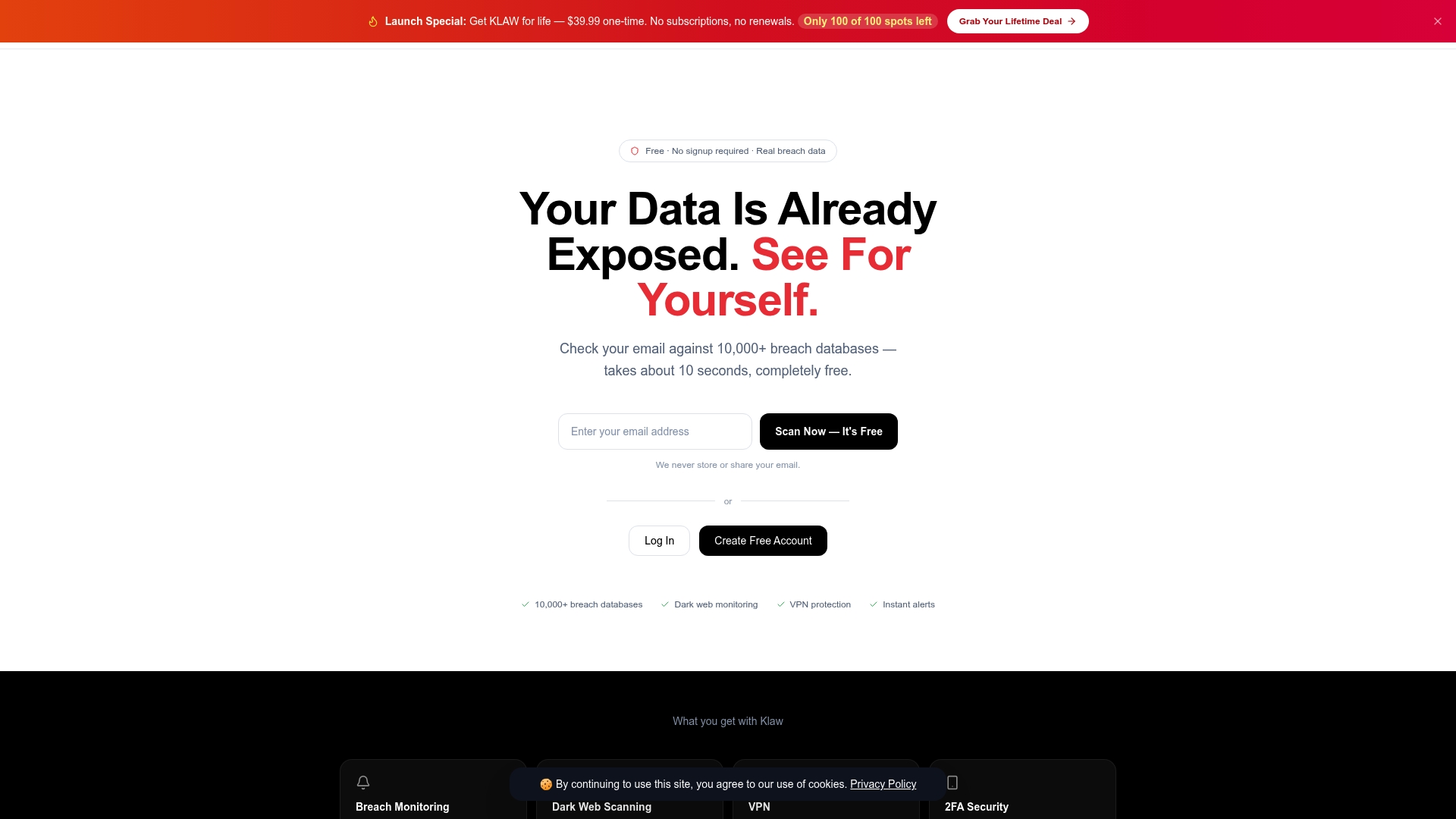
Klaw's Dark Web Alerts notify you when stolen credentials from your business surface on dark web forums, giving you time to act before attackers do. The Threat Alert Settings let you customize exactly which security events trigger a notification, so you get the alerts that matter without the noise. For small business owners who want real-time awareness without a full security team, Klaw delivers the monitoring layer that most SMBs are missing.
FAQ
What is the most common type of small business data breach?
Credential theft is the leading breach vector for small businesses, accounting for 22% of initial access incidents according to the Verizon DBIR 2026. Attackers use stolen usernames and passwords to access email, financial accounts, and customer records.
How long does it take to detect a data breach?
Breaches take an average of 212 days to detect. That delay allows attackers to exfiltrate data, move through your network, and establish persistent access long before you know anything is wrong.
Does multi-factor authentication prevent data breaches?
MFA reduces risk significantly but does not eliminate it. Attackers use Adversary-in-the-Middle attacks and infostealer malware to bypass MFA protections, particularly SMS and push-notification methods.
What should I do first after discovering a breach?
Isolate the affected systems from your network without powering them down, then contact your attorney before making any public statements. Notification laws in most states require disclosure within 30–72 hours, and your attorney helps you classify the incident correctly to avoid additional liability.
Are small businesses required to notify customers after a breach?
Yes. State breach notification laws require businesses to notify all affected individuals in every state where they reside, not just the state where the business is headquartered. Requirements and timelines vary, so legal counsel is critical.