
TL;DR:
- Vendor data breaches involve attackers exploiting third-party vendors to access organizations' data, increasing risk across interconnected systems. Rapidly severing vendor access and maintaining continuous monitoring are critical to reducing the financial and operational impacts of such breaches. Implementing thorough vendor risk management and real-time breach alerts can significantly improve defense against these evolving threats.
Vendor data breaches are defined as security incidents where attackers compromise an organization's data by exploiting a third-party supplier, service provider, or software integration. The vendor data breach risks examples from 2026 alone show how devastating these attacks can be. NYC Health + Hospitals lost control of 1.8 million patient records through a single vendor. The ShinyHunters group hit Anodot, a SaaS analytics provider, and walked away with data touching Google, Cisco, and the European Commission. These are not edge cases. They are the new normal for any organization that shares data with outside vendors.
1. What are common vendor data breach risk scenarios?
Third-party risk management is the formal discipline for controlling vendor data breach risks examples like these. Understanding the most common attack paths is the first step toward defending against them.
- Supply chain compromise. Attackers target a smaller vendor with weaker defenses to reach a larger organization. The KC&D Service breach gave attackers a direct path into Korean Air's systems. The vendor was the door.
- Cascading SaaS failures. A single SaaS vendor breach can expose dozens of downstream clients simultaneously. When Anodot was breached, Zara's 197,400 customer records were exposed as collateral damage.
- Credential and access abuse. Vendors often retain elevated privileges long after a project ends. Attackers find these stale credentials and use them without triggering any alerts.
- Forgotten integrations. Many organizations have vendor API connections they no longer actively use. These inactive links still carry live data access and represent a silent exposure risk.
- Poor vendor patching. When a vendor delays patching a known vulnerability, every client connected to that vendor inherits the risk. The MOVEit Transfer attack is the clearest example of this pattern at scale.
Pro Tip: Run a quarterly audit of every active vendor integration. Revoke any connection that has not been used in 90 days. Dormant access is free real estate for attackers.
The lack of continuous monitoring on vendor service accounts is a consistent thread across these scenarios. Unusual access patterns go unnoticed for weeks or months because no one is watching vendor accounts with the same scrutiny applied to internal ones.
2. Top 6 notable vendor data breach case studies
These six examples of vendor data breaches represent some of the most instructive incidents in recent memory. Each one reveals a different failure point in third-party risk management.
1. NYC Health + Hospitals (2025–2026)
Attackers maintained access through a compromised vendor for approximately 78 days, from November 25, 2025 to February 11, 2026. The result was 1.8 million exposed records, including biometric data. Seventy-eight days of undetected access is not a technology failure alone. It is a monitoring failure.

2. Anodot and ShinyHunters (2026)
The ShinyHunters extortion group breached Anodot, a cloud analytics vendor, and extracted 140GB of data affecting 197,400 Zara customers. Victims also included Google, Cisco, and the European Commission. One vendor. Multiple global organizations. That is the cascading SaaS risk in practice.
3. Financial services vendor breach
A vendor serving a financial firm exposed 100,000 records and generated a $1.75 million total financial impact. The breakdown: $300,000 in forensic and notification costs, $250,000 in regulatory fines, and $1.2 million in lost revenue tied to 8% customer churn over 12 months. The fine was the smallest part of the bill.
4. MOVEit Transfer (2023, ongoing impact)
The MOVEit zero-day SQL injection attack breached over 2,000 organizations and exposed more than 90 million records. Major government agencies and financial institutions worldwide were affected. This is the definitive case study in fourth-party risk: organizations that did not even directly use MOVEit were still exposed through vendors who did.
5. Statement printer vendor compromise
A shared vendor compromise affecting a statement printing service hit multiple financial institutions simultaneously. Citizens and Frost Bank both reported breach claims tied to the same vendor. One vendor failure produced multiple breach disclosures across competing organizations.
6. Korean Air via KC&D Service
A supply chain attack through KC&D Service gave attackers access to Korean Air's internal systems. This case illustrates how a smaller, less-defended vendor becomes the entry point for a much larger target. The attacker's goal was never the vendor. The vendor was just the path.
3. How vendor breaches affect organizations financially
The financial damage from vendor security risk scenarios goes well beyond the initial incident response bill. Understanding the full cost structure changes how you prioritize prevention spending.
| Cost Category | Example Amount | What It Covers |
|---|---|---|
| Forensic and notification | $300,000 | Investigation, legal review, customer notification |
| Regulatory fines | $250,000 | HIPAA, GDPR, state-level penalties |
| Lost revenue | $1,200,000 | Customer churn, contract cancellations |
| Total impact | $1,750,000 | Combined 12-month cost for 100,000 records exposed |
The 8% customer churn figure is the most underappreciated number in that breakdown. Customers who leave after a breach rarely come back. The lost revenue compounds over years, not just the 12 months typically measured in incident reports.
Operational disruption adds another layer of cost that rarely appears in financial summaries. Ransomware propagated through a vendor can lock internal systems for days. Staff hours spent on breach response divert resources from core business operations. Regulatory investigations consume legal and compliance bandwidth for months after the initial incident.
Brand trust erosion is harder to quantify but just as real. Organizations that learn how data breaches happen often discover that their customers had no idea how much third-party access existed. When that access leads to a breach, the trust deficit is compounded by the perception that the organization was not transparent about its vendor relationships.
4. What are practical steps to mitigate vendor data breach risks?
Data breach prevention strategies for vendor risk require a different mindset than traditional perimeter security. The threat is already inside your trusted network by definition.
- Assume vendor compromise as a baseline. Security researcher Nurlan Isazade argues that organizations must architect integrations to minimize blast radius from any single vendor failure. Design your systems as if every vendor is already compromised.
- Prioritize severance time. Organizations that can sever a compromised vendor's access in under one hour are significantly more resilient than those needing a week. Severance time is the primary metric for vendor risk resilience.
- Map your entire vendor chain. Vendor risk inventories must include fourth-party exposures, meaning the vendors your vendors use. MOVEit proved that fourth-party risk is not theoretical.
- Revoke unused credentials immediately. Stale vendor accounts are a persistent attack surface. Review all vendor service accounts monthly and revoke anything inactive.
- Rehearse vendor access revocation. Emergency rehearsal of vendor access revocation processes is critical to minimize data exposure time. A plan that has never been tested will fail under pressure.
- Monitor vendor accounts like internal accounts. Treat vendor service accounts as internal assets. Instrument detailed activity monitoring and anomaly detection on every vendor connection.
Pro Tip: Map your vendor relationships visually, including the tools your vendors use. If a SaaS platform your vendor relies on gets breached, you need to know within hours, not weeks. Tools like ServiceNow Vendor Risk Management or Prevalent can help automate this mapping.
Understanding why address information gets compromised often traces back to vendor integrations that handle customer data without adequate access controls. Reviewing those flows proactively is faster and cheaper than responding to a breach.
Key takeaways
Vendor data breaches cause the most damage when organizations lack visibility into their vendor chains and cannot sever compromised access quickly.
| Point | Details |
|---|---|
| Severance time matters most | Organizations that cut vendor access in under one hour suffer significantly less damage than those that take days. |
| SaaS cascades are a real threat | One breached SaaS vendor can expose dozens of clients simultaneously, as the Anodot incident demonstrated. |
| Financial costs run deep | A 100,000-record vendor breach cost one financial firm $1.75 million, with lost revenue as the largest single expense. |
| Fourth-party risk is not optional | MOVEit exposed 90 million records across 2,000+ organizations, many of which never directly used the software. |
| Continuous monitoring closes the gap | Treating vendor accounts with the same scrutiny as internal accounts is the single most effective detection improvement. |
Why conventional vendor assessments keep failing
I have watched organizations spend weeks building vendor security questionnaires, get them back with perfect scores, and then get breached through that same vendor six months later. The questionnaire is a snapshot. Attackers operate in real time.
The cases I find most instructive are not the massive headline breaches. They are the quiet ones, like the statement printer vendor that hit multiple banks simultaneously. Nobody was watching that vendor because nobody thought a print service was a high-risk integration. That blind spot is where attackers live.
What actually works is treating severance time as a KPI you measure and improve. If your team cannot revoke a vendor's access in under an hour, that is not a policy problem. It is a technical debt problem that needs a budget line. The organizations that recovered fastest from MOVEit were the ones that had already rehearsed this exact scenario.
The uncomfortable truth about how to mitigate vendor risks is that most organizations do not know what they do not know. They cannot see their fourth-party exposures. They have not audited their SaaS integrations in years. The recovery plan after a breach is always more expensive than the prevention work that was skipped. Start with the inventory. Everything else follows from knowing what you actually have.
— Lucky
How Klaw helps you stay ahead of vendor breaches
Vendor breaches rarely announce themselves. By the time a notification arrives, your data may have been circulating on the dark web for weeks.
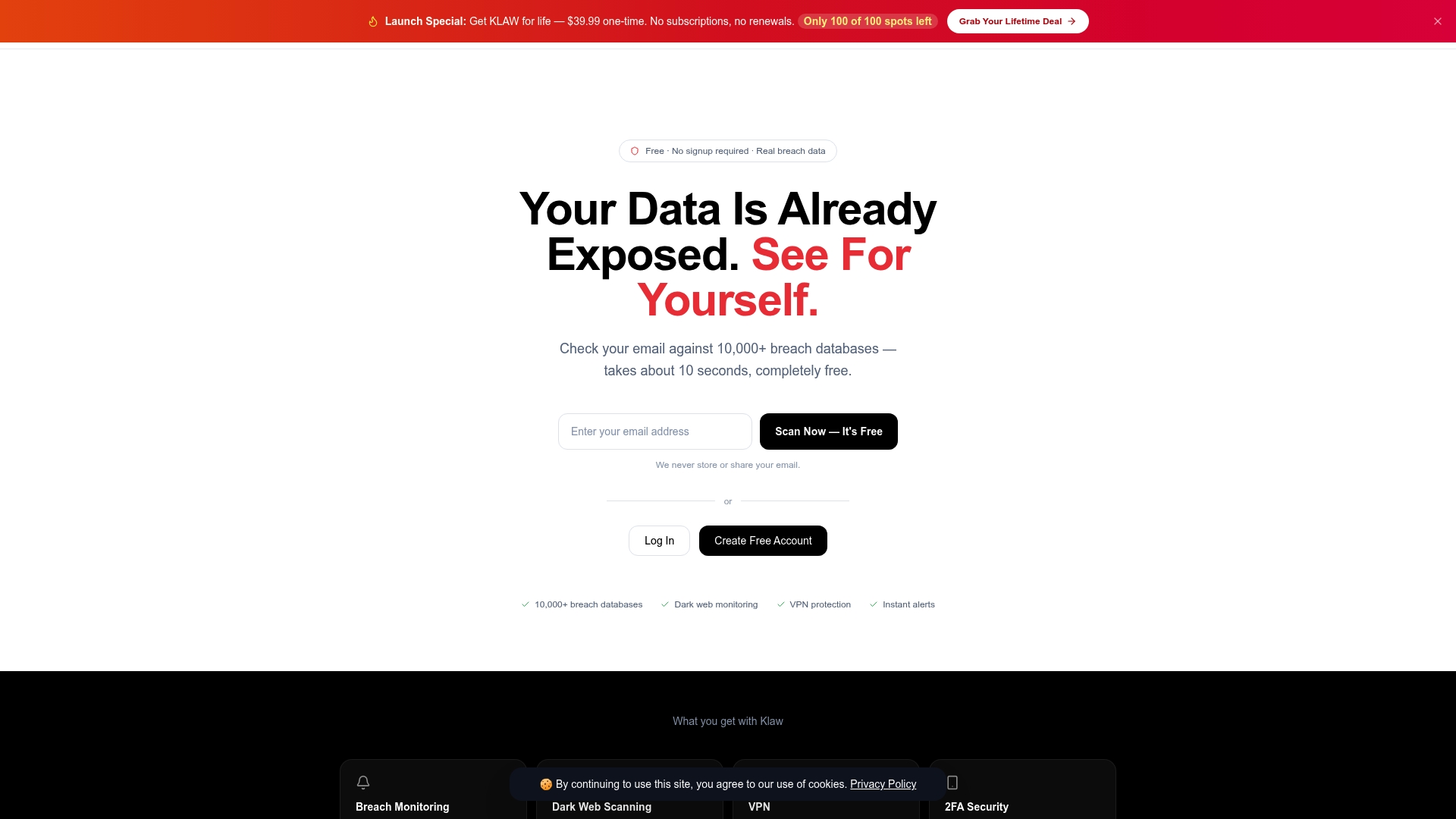
Klaw's Dark Web Alerts scan over 10,000 breach databases continuously, so you get notified the moment your data appears, not after the news cycle picks it up. The Threat Alert Settings let you customize exactly what triggers a notification, cutting through noise to surface what matters to you. The Security Trend Dashboard gives you a visual read on your exposure over time. No hidden fees. No subscriptions required to get started. Klaw gives you the monitoring layer that most vendor contracts do not.
FAQ
What is a vendor data breach?
A vendor data breach occurs when an attacker compromises an organization's data by exploiting a third-party supplier or service provider rather than attacking the organization directly. The vendor's access becomes the attacker's entry point.
How do vendor breaches spread to multiple organizations?
A single shared vendor compromise can affect every client that vendor serves simultaneously. The MOVEit attack hit over 2,000 organizations through one shared file-transfer service.
What is the average cost of a vendor data breach?
One documented financial services case shows a total impact of $1.75 million for 100,000 exposed records, covering forensic costs, regulatory fines, and 12 months of lost revenue from customer churn.
How quickly should you cut off a breached vendor?
Organizations that sever a compromised vendor's access in under one hour are significantly more resilient than those that take a week. Severance time is the primary metric for measuring vendor risk readiness.
How can individuals protect themselves from vendor breaches?
Individuals should monitor their email addresses against breach databases regularly and set up real-time alerts for new exposures. Services like Klaw scan breach disclosure databases and notify you when your data appears.