
TL;DR:
- Dark web data exposure involves releasing stolen personal information on hidden internet markets after a breach. Examples like the Infutor, Grindr, and VUMI breaches highlight how sensitive data from various sources can be permanently compromised. Continuous dark web monitoring and rapid response are essential to mitigating long-term identity theft and fraud risks.
Dark web data exposure is the process by which stolen personal information, including Social Security numbers, passwords, and health records, is published or sold on hidden internet markets after a breach. The scale is staggering. The Infutor breach alone exposed nearly 677 million records containing full names, dates of birth, and SSNs from a single unsecured database. These dark web data exposure examples are not abstract threats. They are documented incidents that show exactly how your personal information travels from a company's server to a criminal marketplace, and what happens to it once it arrives.

1. Real dark web data exposure examples you need to know
The most instructive way to understand dark web data leaks is through specific, documented cases. Each breach below reveals a different attack vector, a different data type, and a different level of personal risk.
The Infutor breach: 677 million records
Infutor, a consumer data firm, left an Elasticsearch database publicly accessible without any authentication. The result was a 91.7 GB exposure of consumer records containing full names, Social Security numbers, addresses, and dates of birth. This is a textbook example of how data brokers, companies you never directly interact with, can expose your most sensitive identifiers. Once SSNs appear on the dark web, they cannot be changed. The damage is permanent.
The Grindr breach: health and location data for 15 million users
Grindr allegedly suffered a breach exposing 15 million users' sensitive records, including HIV status, GPS coordinates, and sexual orientation across 14 or more data fields. This case illustrates a category of exposure that goes far beyond financial fraud. Health status and location data can be weaponized for discrimination, blackmail, or physical harm. No credit monitoring service can undo that kind of exposure.
The VUMI Group breach: insurance documents and passport scans
VUMI Group, an international insurer, suffered a breach that leaked data on 300,000 policyholders and 25,000 staff members. Exposed files included passport scans, W-9 tax forms, and Social Security numbers. This combination is particularly dangerous because it gives criminals everything needed to commit travel fraud and open fraudulent financial accounts simultaneously.
- Infutor: SSNs and address histories from a data broker you never chose
- Grindr: health status and real-time location from an app you trusted
- VUMI Group: government documents and tax records from your insurer
Each case shows a different entry point. Your data is only as safe as the least secure company that holds it.
2. How the dark web turns stolen data into a marketplace
Dark web marketplaces operate with more structure than most people expect. Stolen data is categorized by industry, geography, and company size, which lets criminals target victims with precision. A listing might specify "U.S. healthcare employees, Pacific Northwest, mid-size firms" alongside a price per record. That level of segmentation means your data is not just dumped randomly. It is packaged and sold to buyers with specific criminal goals.
Common listings include employee credentials, session tokens, VPN access credentials, and full identity profiles. Session tokens are especially dangerous because they let attackers bypass passwords entirely and log into accounts as if they were you. Ransomware groups add another layer of risk by publishing stolen data progressively on public leak sites, meaning your information stays accessible even if the original attacker moves on.
Pro Tip: Search your email address on a breach monitoring tool like Klaw before assuming you are safe. Many people discover their data was sold years before they were notified.
The market for stolen personal data is self-sustaining. Buyers resell records, combine datasets from multiple breaches, and build detailed profiles that are far more valuable than any single leaked file.
3. How your data ends up on the dark web
Understanding how data appears on the dark web helps you identify your own vulnerabilities. The path from your personal information to a criminal listing usually follows one of a few well-documented routes.
-
Third-party vendor breaches. Nearly a third of breaches involve third parties. Your data can be exposed through a payroll processor, a cloud storage vendor, or a loyalty program you signed up for years ago. You have no direct control over their security practices.
-
Phishing attacks. A convincing fake login page or email captures your credentials before you realize what happened. The stolen password is uploaded to a dark web market within hours.
-
Infostealer malware. This is the most underestimated threat. Variants like LummaC2 and RedLine silently extract every password saved in your browser and every active session cookie, then upload the results automatically. You do not need to click a suspicious link. Simply having the malware installed is enough.
-
Unsecured databases. As the Infutor case shows, companies sometimes misconfigure cloud storage or databases, leaving them publicly accessible. Automated scanners find these within hours of exposure.
-
Ransomware leak sites. When organizations refuse to pay ransoms, attackers publish internal files. If your data was in those files, it is now public regardless of what the company decides.
Knowing these routes matters because each one requires a different protective response. A data breach at a vendor you trust is not something you can prevent. But you can detect it faster and respond before the damage compounds.
4. What types of personal data are most at risk
Not all exposed data carries the same long-term risk. The critical distinction is between data you can change and data you cannot.
Changeable data includes passwords, email addresses, and credit card numbers. These are serious when exposed, but you can reset them. The damage is containable if you act quickly.
Permanent data is a different category entirely. Social Security numbers, medical history, biometric data, and sexual orientation cannot be reset once exposed. The Grindr breach made this point sharply. HIV status and GPS history are not credentials. They are facts about a person's life, and they remain on dark web markets indefinitely. The Infutor breach reinforced this with SSNs tied to full identity profiles. Criminals can use that data to open credit lines, file fraudulent tax returns, or impersonate you for years.
Understanding this distinction changes how you should respond to a breach notification. A leaked password calls for a password reset. A leaked SSN calls for a fraud alert with the three major credit bureaus, Equifax, Experian, and TransUnion, and long-term monitoring.
5. Preventative steps after reviewing dark web exposure examples
Learning from examples of dark web exposure is only useful if it leads to concrete action. These steps address the most common failure points revealed by real breach cases.
-
Set up continuous dark web monitoring. A one-time scan tells you about past exposure. Continuous monitoring alerts you when new data appears, which matters because threat actors often list stolen data months or years after the original breach. Services like Klaw scan against over 10,000 breach databases and send real-time alerts.
-
Change passwords immediately upon any alert. Do not wait to confirm the breach scope. Reset the affected account first, then investigate. Immediate password resets and MFA activation are the two most effective first responses.
-
Stop reusing passwords. Password reuse is the single biggest amplifier of breach damage. One leaked credential becomes access to every account sharing that password. Use a password manager like Bitwarden or 1Password to generate unique credentials for every site.
-
Place a credit freeze if permanent data was exposed. A freeze at Equifax, Experian, and TransUnion prevents new credit lines from being opened in your name. It costs nothing and is the most direct defense against SSN-based fraud.
-
Monitor for fraud beyond your financial accounts. If health data was exposed, watch for fraudulent medical claims filed under your name. If passport data was leaked, check for unauthorized travel document applications.
Pro Tip: Dark web monitoring is a tripwire, not a shield. It tells you when exposure has occurred. Your response speed determines how much damage follows. Set up automated monitoring alerts so you never find out weeks late.
The permanence of some exposed data means vigilance cannot be a one-time event. Treat dark web monitoring the same way you treat smoke detectors: always on, checked regularly, and taken seriously the moment it triggers.
Key takeaways
Dark web data exposure is permanent for certain data types, making continuous monitoring and fast response the only effective defense against identity theft and fraud.
| Point | Details |
|---|---|
| Permanent data is irreversible | SSNs, health records, and biometrics cannot be reset once exposed on the dark web. |
| Third parties are a major risk | Nearly a third of breaches originate from vendors, not your own accounts or devices. |
| Infostealer malware is silent | LummaC2 and RedLine steal browser credentials without any user interaction required. |
| Continuous monitoring beats one-time scans | Threat actors list stolen data months or years post-breach, so alerts must be ongoing. |
| Response speed limits damage | Immediate password resets and MFA activation are the two most effective first actions after any alert. |
Why these breach examples changed how I think about personal data
I used to believe that careful online behavior was enough protection. Don't click suspicious links. Use strong passwords. Avoid sketchy websites. The Infutor and VUMI Group breaches dismantled that logic completely.
Your data sits inside dozens of companies you never consciously chose. Data brokers, insurers, payroll processors, and loyalty programs all hold pieces of your identity. You cannot audit their security. You cannot opt out of their databases in most cases. And when they fail, your SSN or passport scan ends up on a dark web market before you receive any notification.
What shifted my thinking most was the distinction between changeable and permanent data. I had always treated a breach notification as a password problem. Reset the password, move on. But the Grindr case showed that health status and location history are a completely different category of risk. There is no reset. There is only monitoring and damage control.
The practical lesson I keep coming back to is this: reactive security is not security at all. By the time you receive a breach notification letter in the mail, your data has often been available on dark web markets for months. The only posture that actually works is continuous, automated monitoring paired with a clear response plan. Tools like Klaw exist precisely for this reason. They close the gap between when exposure happens and when you find out.
If you have not checked your email addresses against breach databases recently, that gap is open right now.
— Lucky
Protect your personal data with Klaw's dark web monitoring
Knowing these breach examples is the first step. Acting on that knowledge is what actually protects you.
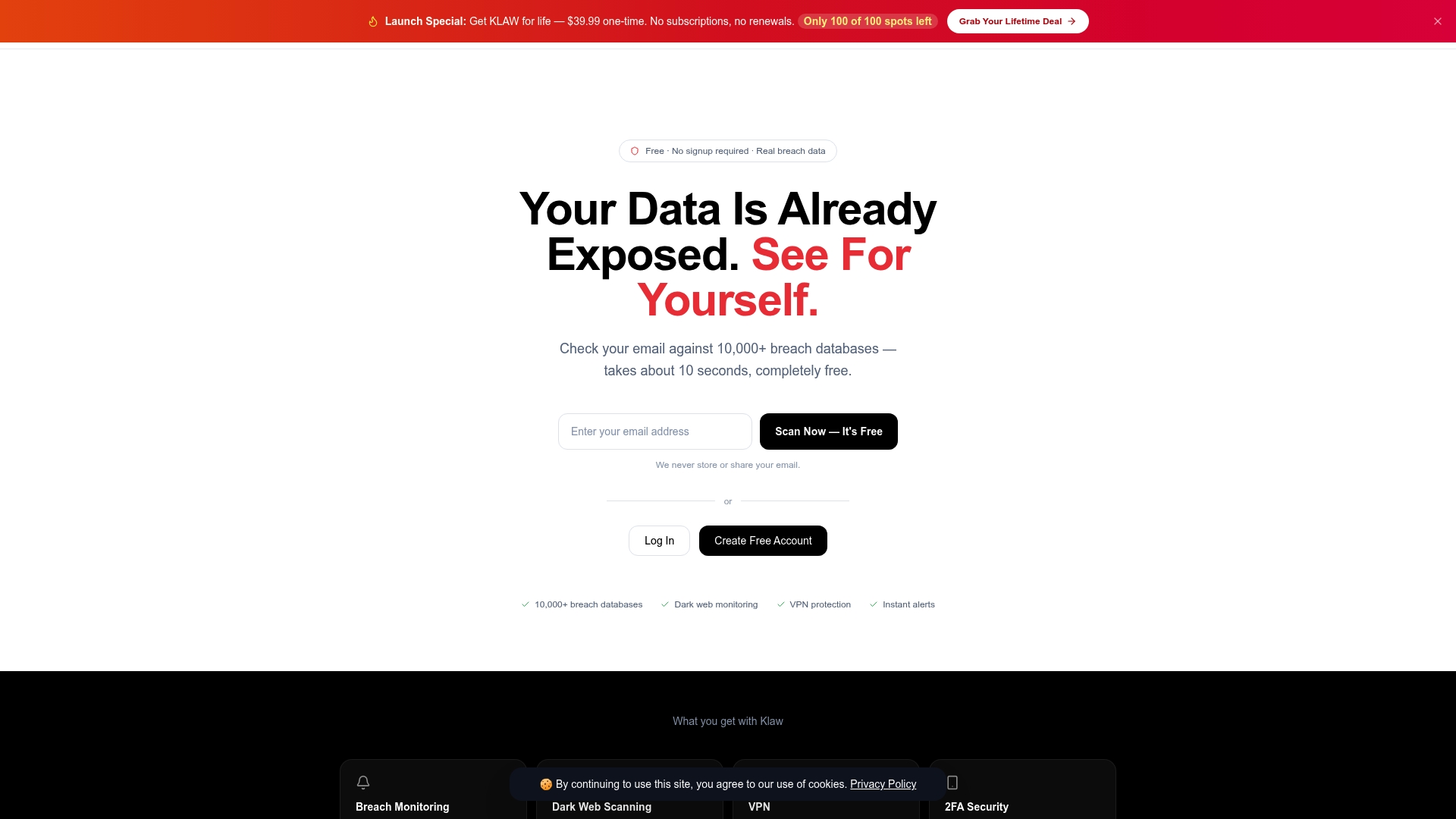
Klaw's Dark Web Alerts scans your email addresses against over 10,000 breach databases and sends real-time notifications the moment your data appears in a new leak. There are no hidden fees and no subscriptions required to get started. If your information is already exposed, Klaw provides recovery guidance and automated data broker removal to reduce your ongoing risk. For an added layer of privacy, Klaw's VPN service keeps your online activity protected while you monitor your exposure. Start your free scan today and find out exactly where you stand.
FAQ
What are the most common dark web data exposure examples?
The most documented cases include the Infutor breach (677 million SSNs), the Grindr breach (15 million health and location records), and the VUMI Group breach (300,000 policyholder passport scans and tax forms). Each illustrates a different source and data type.
How does personal data appear on the dark web?
Personal data reaches dark web markets through third-party vendor breaches, phishing attacks, infostealer malware like LummaC2 and RedLine, and misconfigured databases. Ransomware groups also publish stolen files on public leak sites when victims refuse to pay.
Can exposed Social Security numbers be removed from the dark web?
No. Once an SSN is published on a dark web market, it cannot be removed or reset. The recommended response is placing a credit freeze with Equifax, Experian, and TransUnion and enrolling in continuous dark web monitoring for long-term fraud detection.
How long does stolen data stay on the dark web?
Stolen data can remain available for months or years after the original breach. Threat actors frequently relist or resell records long after the initial exposure, which is why ongoing monitoring is more effective than a single one-time scan.
What should I do immediately after a dark web exposure alert?
Reset the affected account password immediately and enable multi-factor authentication. If permanent data like an SSN was exposed, place a credit freeze and monitor for fraudulent activity across financial, medical, and government accounts.